Question
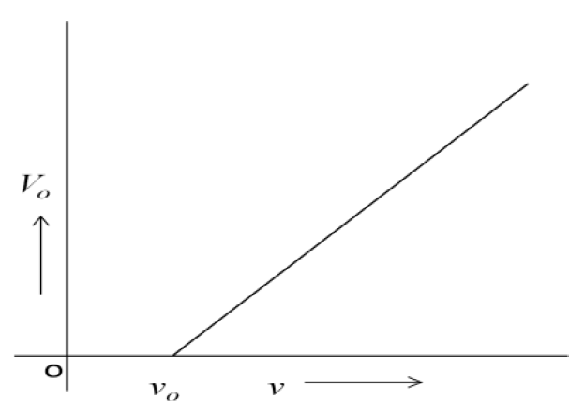
State two important properties of photon which are used to write Einstein's photoelectric equation. Define (i) Stopping potential and (ii) Threshold frequency, using Einstein's equation and drawing necessary plot between relevant quantities.
Answer

Properties of Photon:
  1. For a radiation of frequency$\upsilon$, each photon has an energy, $\text{E} = \text{h}v,$ associated with it.
  2. The energy of a photon is independent of the intensity of incident radiation.
  3. During the collision of a photon, with an electron, the total energy of the photon gets absorbed by the electron.
Einstein’s photoelectric equation is,

$\text{K}_{max} = \text{hv} - \phi_{0}$

or $\text{eV}_{0} = \text{hv} -\phi_{0}$
  1. Stopping potential, $\text{V}_{0}$ equals that value of the negative potential for which
$|\text{eV}_{0}| =\text{K}_{max}$

Alternate Answer

(The stopping potential ($\text{V}_{0}$) equals that (least) value of the (negative) plate potential that just stops the most energetic emitted photoelectrons from reaching the plate.)
  1. Threshold frequency $(\vartheta_{o})$ equals that value of the frequency of incident radiation for which $\text{K}_{max} = 0 . $
Alternate Answer

(For a given photosensitive surface, its threshold frequency is the minimum value of the frequency of incident radiation for which photoelectrons can be just emitted from that surface or that maximum frequency of incident radiation below which no photo emission takes place.)

The plot, between $\text{V}_{0}$ and$\vartheta , $ , has the form shown:

Need a full question paper?

Generate a complete, print-ready paper with questions like this in minutes — across 16+ boards, with answer keys.

Start Generating Free

Similar questions

Explain giving reasons for the following:
  1. Photoelectric current in a photocell increases with the increase in the intensity of the incident radiation.
  2. The stopping potential $(V_0)$ varies linearly with the frequency (v) of the incident radiation for a given photosensitive surface with the slope remaining the same for different surfaces.
  3. Maximum kinetic energy of the photoelectrons is independent of the intensity of incident radiation.
Find the radius of gyration of a circular ring of radius r about a line perpendicular to the plane of the ring and passing through one of its particles.
A capacitor is connected to an alternating-current source. Is there a magnetic field between the plates?
Explain the behaviour of non polar molecule and polar molecule in uniform electric field.
How does a charge oscillating with any frequency produces electromagnetic waves? Draw a schematic diagram by showing electric and magnetic fields for an electromagnetic wave transmitting along Z-axis.
Using Gauss’s theorem, show mathematically that for any point outside the shell, the field due to a uniformly charged thin spherical shell is the same as if the entire charge of the shell is concentrated at the centre. Why do you expect the electric field inside the shell to be zero according to this theorem?
A converging lens and a diverging mirror are placed at a separation of 15cm. The focal length of the lens is 25cm and that of the mirror is 40cm. Where should a point source be placed between the lens and the mirror so that the light, after getting reflected by the mirror and then getting transmitted by the lens, comes out parallel to the principal axis?
Figure shows a cart. Complete the table shown.
The work function for the following metals is given:
Na: 2.75 eV; K: 2.30 eV; Mo: 4.17 eV; Ni: 5.15 eV. Which of these metals will not give photoelectric emission for a radiation of wavelength 3300 Å from a He-Cd laser placed 1 m away from the photocell? What happens if the laser is brought nearer and placed 50 cm away?
A charge Q is uniformly distributed over a rod of length l. Consider a hypothetical cube of edge l with the centre of the cube at one end of the rod. Find the minimum possible flux of the electric field through the entire surface of the cube.