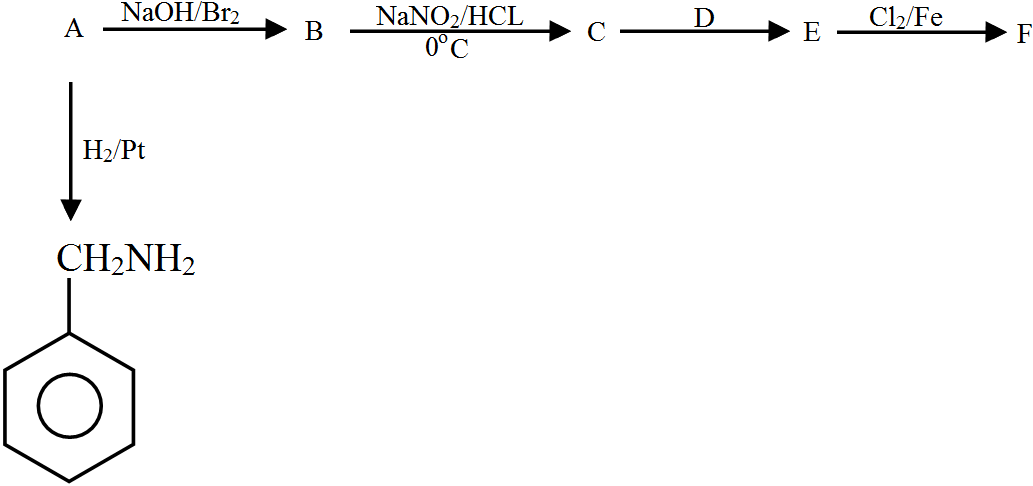
Question
  1. State two main differences between globular proteins and fibrous proteins.
  2. Based on their chemical composition, state how are lipids classified Give one example of each class.

Answer

  1. Sr. No.
    Globular Proteins
    Fiberous Proteins
    I.
    II.
    They are cross linked condensation products .
    Three dimensional spherical shape.
    They are linear condensation products.
    Rod like rigid shape.
  2. Lipids are naturally occuring compounds related to fatty acids which include fats, oils, waxes, etc.

  1. Simple lipids (Homolipids): e.g, neutral fats/waxes.
  2. Compound Lipids (Hetrolipids): e.g, Phospholopids/Glycolipids.
  3. Derived Lipids: fatty acids/fatty alcohols/steroids/terpenes, etc.

Need a full question paper?

Generate a complete, print-ready paper with questions like this in minutes — across 16+ boards, with answer keys.

Start Generating Free

Similar questions

Calculate the depression in the freezing point of water when 10 g of CH3CH2CHClCOOH is added to 250 g of water. Ka = 1.4 × 10⁻³, Kf = 1.86 K kg mol–1.
Answer the following questions:
Write balanced equations to represent what happens when.
  1. Cu2+ is treated with KI.
  2. Acidified potassium dichromate solution is reacted with iron (II) solution. (ionic equation).
Write the rate law for a first order reaction. Justify the statement that half life for a first order reaction is independent of the initial concentration of the reactant.
Match the complex ions given in Column I with the colours given in Column II and assign the correct code:
 
Column I (Complex ion)
 
Column II (Colour)
a.
[Co(NH3)6]3+
1.
Violet
b.
[Ti(H2O)6]3+
2.
Green
c.
[Ni(H2O)6]2+
3.
Pale blue
d.
[Ni(H2O)4(en)]2+ (aq)
4.
Yellowish orange
 
 
5.
Blue
Code:
  1. A (1), B (2), C (4), D (5).
  2. A (4), B (3), C (2), D (1).
  3. A (3), B (2), C (4), D (1).
  4. A (4), B (1), C (2), D (3).
Answer the following questions.
Comment on the specificity of enzyme action. What is the most important reason for their specificity?
Describe the preparation of potassium permanganate. How does the acidified permanganate solution react with (i) iron(II) ions (ii) SO2 and (iii) oxalic acid? Write the ionic equations for the reactions.
Answer the following question:
Write mechanism of the reaction of HI with methoxymethane.
At 291K, the molar conductivities at infinite dilution of NH4Cl, NaOH and NaCl are 129.8, 217.4 and 108.9S cm2 mol-1 respectively. If the molar conductivity of a centinormal solution of NH4OH is 9.33S cm2 mol-1, what is the percentage dissociation of NH4OH at this dilution? Also calculate the dissociation constant of NH4OH.
Match the complex ions given in Column I with the hybridisation and number of unpaired electrons given in Column II and assign the correct code:
 
Column I (Complex ion)
 
Column II (Hybridisation, number of unpaired electrons)
a.
[Cr(H2O)6]3+
1.
dsp2, 1
b.
[Co(CN)4]2-
2.
sp3d2, 5
c.
[Ni(NH3)6]2+
3.
d2sp3, 3
d.
[MnF6]4-
4.
sp3, 4
 
 
5.
sp3d2, 2
Code:
  1. A (3), B (1), C (5), D (2).
  2. A (4), B (3), C (2), D (1).
  3. A (3), B (2), C (4), D (1).
  4. A (4), B (1), C (2), D (3).