Question
State two methods of increasing the stability of the body.

Answer

The stability off a body is increased if:
(i) The centre of gravity is as low as possible. It should be above the base and near the geometric centre of the body. This is the case when the mass of the body is large at the bottom.
(ii) The area of the base of the body is large so that the vertical line through the CG of the body passes through its base. If the body is slightly tilted, its CG rises higher and it has a tendency to regain its original position to lower the CG.

Need a full question paper?

Generate a complete, print-ready paper with questions like this in minutes — across 16+ boards, with answer keys.

Start Generating Free

Similar questions

'Radioactivity is a nuclear phenomenon'. Comment on this statement.
Derive an expression for the amount of heat given out or taken up, when its temperature falls or rises by t°C.
On what factors does the resistance of a conductor depend?
$250 g$ of water at $30^{\circ} C$ is present in a copper vessel of mass 50 g . Calculate the mass of ice required to bring down the temperature of the vessel and its contents to $5^{\circ} C$.
Specific latent heat of fusion of ice $=336 \times 10^3 J kg ^{-1}$
Specific heat capacity of copper vessel $=400 J kg ^{-1}{ }^{\circ} C ^{-1}$
Specific heat capacity of water $=4200 J kg ^{-1}{ }^{\circ} C ^{-1}$.
What do you mean by power rating of an electrical appliance? How do you use it to calculate

(a) the resistance of the appliance and

(b) the safe limit of the current in it, while in use?
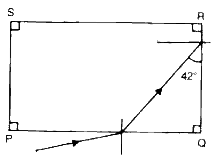
It is dangerous to connect the switch in the neutral wire. Explain your answer.
(a) A ray of monochromatic light enters glass $PQRS$ as shown in the fig. Complete the path of ray till it emerges from the glass. (Critical angle of glass is $42^0).$

(b) Draw diagram of a prism periscope.
(c) What are the advantages of total internal reflecting prism over plane mirror?
In an experiment, $17 g$ of ice is used to bring down the temperature of $40 g$ of water at $34^{\circ} C$ to its freezing temperature. The specific heat capacity of water is $4.2 Jkg ^{-1} K ^{-1}$. Calculate the specific latent heat of ice. State one important assumption made in the above calculation.
A current-carrying solenoid is suspended so as to freely rotate in a horizontal plane. State in what direction will it rest. Give a reason for your answer.

or

When a solenoid that is carrying current is freely suspended, it comes to rest in a particular direction. Why does this happen?

The pulley system shown in the figure is to be used to lift a load W. If the man applying the effort cannot apply a force exceeding 1000 N, what is the maximum load that can be lifted?
The actual load that the man is finally able to lift turns out to be 2700 N. What are the values of the actual M.A., obtained, and the efficiency of the actual set-up?