Question
On what factors does the resistance of a conductor depend?

Answer

Factors on which the resistance of a conductor depends:
  1. Length of conductor: Resistance is directly proportional to the length of the conductor. This means Resistance increases with an increase in the length of the conductor. This is the cause that long electric wires create more resistance to the electric current.
  2. Area of cross-section: Resistance is inversely proportional to the area of the cross-section of the conductor. This means Resistance will decrease with an increase in the area of the conductor and vice versa. This is the cause that thick copper wire creates less resistance to the electric current.
  3. Temperature: Resistance is directly proportional to the temperature.
  4. Nature of material: Some materials create the least hindrance and hence are called good conductors. Silver is the best conductor of electricity. While some other materials create more hindrance in the flow of electric current, i.e. flow of electrons through them. Such materials are called bad conductors. Bad conductors are also known as insulators. The hard plastic is one of the best insulators of electricity.

Need a full question paper?

Generate a complete, print-ready paper with questions like this in minutes — across 16+ boards, with answer keys.
Start Generating Free

Similar questions

State two methods of increasing the stability of the body.
Calculate the total amount of heat required to convert 100g ice at 0°C to steam at 100°C.
(Specific latent heat of fusion of ice = 336 J/g, specific latent heat of vaporization of steam = 2260 J/g, specific heat capacity of water = 4.2 J/g°C).
State the limitations of Ohm’s law.
 A sound wavelength of 0.332 m has a time period of $10^{-3} s$. If the time period is decreased to $10^{-4} s$, calculate the wavelength and frequency of the new wave.
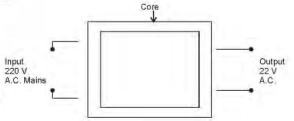
The diagram shows a core of a transformer and its input and output connection.
(a) State the material used for the core and describe its structure.
(b) Use the given data in the diagram to calculate the turn ratio for the transformer.
(c) Complete the diagram of the transformer and connections by labelling all parts added by you.
(d) If a current of $2 A$ is taken from the output, calculate the current in the input circuit. (Assume transformer is ideal).
Image
The voltage of power generated at the generating stations is first stepped up before its transmission. Give reason.
What happens to the position of an element in the periodic table when it emits an alpha particle
The power supply to the primary coil of a transformer is 200 W. Find
(i) Current in primary coil if the e.m.f. supply to it is equal to 220V.
(ii) The number of turns in the primary coil is equal to 80 and that in secondary is 800. What is the transformation ratio?
(iii) Name the type of transformer.
(iv) What will be the output voltage?
(v) What is the current in the secondary coil for an ideal transformer?
(vi) What is the output power?
(vii) Is output and input power equal?
(viii) Compare the current flowing in a secondary coil and in a primary coil.
A nucleus $\ce {^A_Z X}$ emits 2 α particles and 1 β particles to form a nucleus $\ce {^222_85 R}$. Find the atomic nucleus and mass number of X.
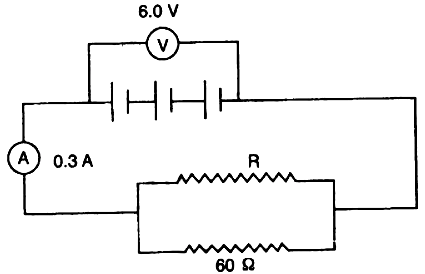
In the figure below, the ammeter A reads $0.3 A$. Calculate:
(i) the total resistance of the circuit
(ii) the value of $R$
(iii) the current flowing through$ R.$