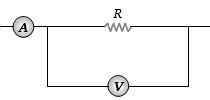
The ammeter $A$ reads $2\, A$ and the voltmeter $V$ reads $20\, V$. the value of resistance $R$ is (Assuming finite resistance's of ammeter and voltmeter)
Easy
Download our app for free and get started
(c) $2R > 20 \Rightarrow R > 10\,\Omega $.

Download our appand get started for free
Experience the future of education. Simply download our apps or reach out to us for more information. Let's shape the future of learning together!No signup needed.*
Similar Questions
- 1In a potentiometer circuit a cell of $EMF$ $1.5\, {V}$ gives balance point at $36\, {cm}$ length of wire. If another cell of $EMF$ $2.5\, {V}$ replaces the first cell, then at what length of the wire, the balance point occurs ? (in $cm$)View Solution
- 2Two bulbs, one of $50\, watt$ and another of $25\, watt$ are connected in series to the mains. The ratio of the currents through them isView Solution
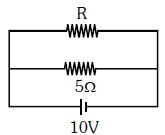
- 3The power dissipated in the circuit shown in the figure is $30\, Watts$. The value of $R$ is ............. $\Omega$View Solution
- 4A circuit of resistacne $R$ is connected to $n$ similar cells. If the current in the circuit is the same when the cells are connected in series or in parallel. If the internal resistacne $r$ of each cell thenView Solution
- 5A house is served by $220\, V$ supply line in a circuit protected by a $9\, ampere$ fuse. The maximum number of $60\, W$ lamps in parallel that can be turned on, isView Solution
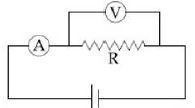
- 6The actual value of resistance $R$, shown in the figure is $30\,\Omega $. This is measured in an experiment as shown using the standard formula $R = \frac{V}{I}$ where $V$ and $I$ are the readings of the voltmeter and ammeter, respectively. If the measured value of $R$ is $5\%$ less, then the internal resistance of the voltmeter is ................. $\Omega$View Solution
- 7The terminal potential difference of a cell when short-circuited is ($E$ = $E.M.F.$ of the cell)View Solution
- 8The internal resistance of a $2.1\, V$ cell which gives a current of $0.2\, A$ through a resistance of $10\,\Omega$ is ............. $\Omega$View Solution
- 9A wire $50\, cm$ long and $1\;mm^2$ in cross -section carries a current of $4\; A$ when connected to a $2\; V$ battery. The resistivity of the wire isView Solution
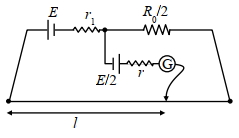
- 10In order to measure the internal resistance $r_1$ of a cell of emf $E$, a meter bridge of wire resistance $R_0=50 \Omega$, a resistance $R_0 / 2$, another cell of emf $E / 2$ (internal resistance $r$ ) and a galvanometer $G$ are used in a circuit, as shown in the figure. If the null point is found at $l=72 cm$, then the value of $r_1=$ . . . . $\Omega$View Solution