Two bulbs, one of $50\, watt$ and another of $25\, watt$ are connected in series to the mains. The ratio of the currents through them is
Easy


Download our appand get started for free
Experience the future of education. Simply download our apps or reach out to us for more information. Let's shape the future of learning together!No signup needed.*
Similar Questions
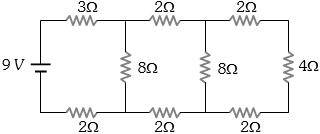
- 1View SolutionIn the circuit shown in the figure, the current through
- 2The resistance of a wire is $R\; ohm$. If it is melted and stretched to $'n'$ times its original length, its new resistance will beView Solution
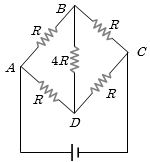
- 3Five resistors of given values are connected together as shown in the figure. The current in the arm $BD$ will beView Solution
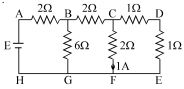
- 4The figure shows a network of resistors and $a$ battery. If $1\,A$ current flowsthrough the branch $CF$, then answer the following questions The current throughView Solution
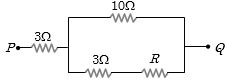
- 5In the circuit shown here, what is the value of the unknown resistor $R$ so that the total resistance of the circuit between points $P$ and $Q$ is also equal to $R$View Solution
- 6In an experiment of meter bridge, a null point is obtained at the centre of the bridge wire. When a resistance of $10\, ohm$ is connected in one gap, the value of resistance in other gap is ............. $\Omega$View Solution
- 7We have a galvanometer of resistance $25\,\Omega $. It is shunted by a $2.5\,\Omega $ wire. The part of total current that flows through the galvanometer is given asView Solution
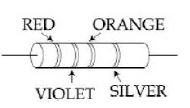
- 8View SolutionA resistance is shown in the figure. Its value and tolerance are given respectively by
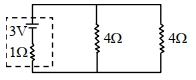
- 9View SolutionIn the given circuit, the terminal potential difference of the cell is:
- 10The length of a potentiometer wire is $l$. $A$ cell of $\mathrm{emf}$ $E$ is balanced at a length $l/3$ from the positive end of the wire. If the length of the wire is increased by $l/2$. At what distance will the same cell give a balance point.View Solution