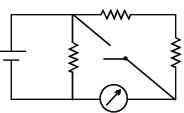
A house is served by $220\, V$ supply line in a circuit protected by a $9\, ampere$ fuse. The maximum number of $60\, W$ lamps in parallel that can be turned on, is
Easy
Download our app for free and get started
(d) $220 \times 9 = n(60)$ $ \Rightarrow $ $n = 33$

Download our appand get started for free
Experience the future of education. Simply download our apps or reach out to us for more information. Let's shape the future of learning together!No signup needed.*
Similar Questions
- 1View SolutionIt is easier to start a car engine on a hot day than on a cold day. This is because the internal resistance of the car battery
- 2A circuit of resistacne $R$ is connected to $n$ similar cells. If the current in the circuit is the same when the cells are connected in series or in parallel. If the internal resistacne $r$ of each cell thenView Solution
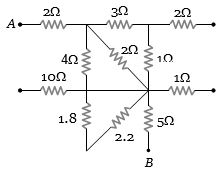
- 3What is the equivalent resistance between the points $A$ and $B$ of the network .................. $\Omega$View Solution
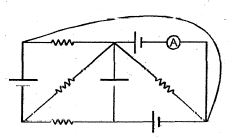
- 4In the circuit diagram shown, each battery is ideal having an e.m.f. of $1\ volt$. Each resistor has a resistance of $1\Omega $ Ammotor$(A)$ has a resistance of $1\Omega $ Find the reading of the ammeter and the total thermal power produced in the circuitView Solution
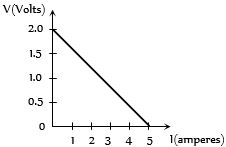
- 5For a cell, the graph between the potential difference $(V) $ across the terminals of the cell and the current $(I)$ drawn from the cell is shown in the figure. The $e.m.f.$ and the internal resistance of the cell areView Solution
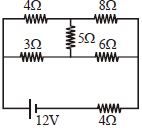
- 6In the given figure the ratio of current in $8\,\Omega $ and $3\,\Omega $ will beView Solution
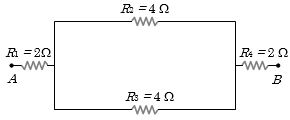
- 7In the given figure, the equivalent resistance between the points $A$ and $B$ is ............ $\Omega$View Solution
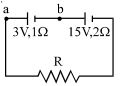
- 8Two batteries one of the $\mathrm{emf}$ $3\,V$, internal resistance $1$ ohm and the other of $\mathrm{emf}$ $15\, V$, internal resistance $2$ $\mathrm{ohm}$ are connected in series with a resistance $R$ as shown. If the potential difference between $a$ and $b$ is zero the resistance of $R$ in $\mathrm{ohm}$ isView Solution
- 9An unknown resistance $R_1$ is connected in series with a resistance of $10 \,\Omega$. This combinations is connected to one gap of a meter bridge while a resistance $R_2$ is connected in the other gap. The balance point is at $50\, cm$. Now, when the $10 \,\Omega$ resistance is removed the balance point shifts to $40\, cm$. The value of $R_1$ is (in $ohm$)View Solution
- 10In the circuit shown, the reading of the Ammeter is doubled after the switch is closed. Each resistor has a resistance $1\,\Omega$ and the ideal cell has an $e.m.f.$ $10\,V$. Then, the Ammeter has a coil resistance equal to ............ $\Omega$View Solution