The amplitude of a damped oscillator decreases to $0.9$ times its original magnitude in $5\ s$. In another $10\ s$ it will decrease to $\alpha $ times its original magnitude, where $\alpha $ equals
JEE MAIN 2013, Medium
Download our app for free and get started
$\because A=A_{0} e^{-\frac{b t}{2 m}}\left(\text { where }, A_{0}=\text { maximum amplitude }\right)$
$ According \,to \,the\, questions,\, after\, 5\, second, $
$0.9 \mathrm{A}_{0}=\mathrm{A}_{0} \mathrm{e}^{-\frac{\mathrm{b}(5)}{2 \mathrm{m}}}$ $...(i)$
$After\, 10 \,more\, second,$
$A=A_{0} \mathrm{e}^{-\frac{\mathrm{b}(15)}{2 \mathrm{m}}}$ $...(ii)$
From eq"s $(i)$ and $(ii)$
$A=0.729 A_{0} \therefore \alpha=0.729$

Download our appand get started for free
Experience the future of education. Simply download our apps or reach out to us for more information. Let's shape the future of learning together!No signup needed.*
Similar Questions
- 1A uniform spring of force constant $k$ is cut into two pieces, the lengths of which are in the ratio $1 : 2$. The ratio of the force constants of the shorter and the longer pieces isView Solution
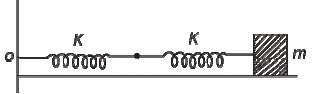
- 2The frequency of oscillations of a mass $m$ connected horizontally by a spring of spring constant $k$ is $4 Hz$. When the spring is replaced by two identical spring as shown in figure. Then the effective frequency is,View Solution
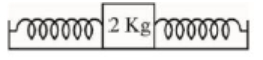
- 3A block of mass $2\,kg$ is attached with two identical springs of spring constant $20\,N / m$ each. The block is placed on a frictionless surface and the ends of the springs are attached to rigid supports (see figure). When the mass is displaced from its equilibrium position, it executes a simple harmonic motion. The time period of oscillation is $\frac{\pi}{\sqrt{x}}$ in SI unit. The value of $x$ is $..........$View Solution
- 4Two identical pendulums oscillate with a constant phase difference $\frac{\pi}{4}$ and same amplitude. If the maximum velocity of one is $v$, the maximum velocity of the other will be ........View Solution
- 5A particle of mass $2 \,kg$, executing $SHM$ has amplitude $20 \,cm$ and time period $1 \,s$. Its maximum speed is ......... $m / s$View Solution
- 6If the length of the simple pendulum is increased by $44\%$, then what is the change in time period of pendulum ..... $\%$View Solution
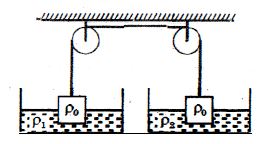
- 7Consider two identical cylinders [each of mass $m$ density $\rho _0$ horizontal cross-section area $s$] in equilibrium, partially submerged in two containers filled with liquids of densities $\rho_1$ and $\rho_2$ as shown in figure. Find the period of small oscillations of this system about its equilibrium. Neglect the changes in the level of liquids in the containers. Neglect mass of the strings. acceleration due to gravity is $g$ . ($v$ is volume of each block)View Solution
- 8A particle in $S.H.M.$ is described by the displacement function $x(t) = a\cos (\omega t + \theta )$. If the initial $(t = 0)$ position of the particle is $1\, cm $ and its initial velocity is $\pi \,cm/s$. The angular frequency of the particle is $\pi \,rad/s$, then it’s amplitude isView Solution
- 9Two particles are executing simple harmonic motion of the same amplitude $A$ and frequency $\omega $ along the $x-$ axis. Their mean position is separated by distance $X_0 (X_0> A)$. If the maximum separation between them is $(X_0 +A)$, the phase difference between their motion isView Solution
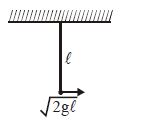
- 10A simple pendulum having length $\ell $ is having speed $\sqrt {2g\ell }$ at bottom most point of its trajectory. Its motion will beView Solution