Question
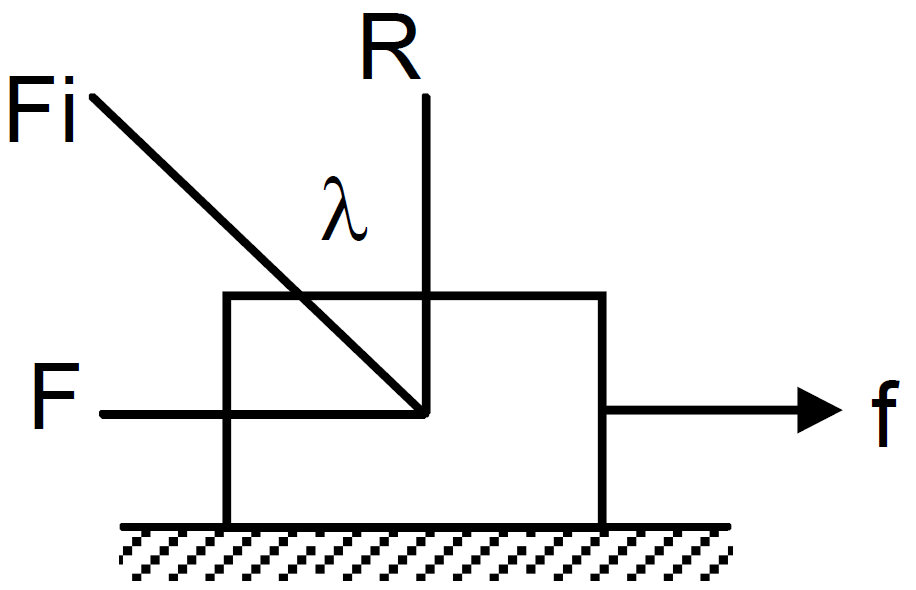
The angle between the resultant contact force and the normal force exerted by a body on the other is called the angle of friction. Show that, if $\lambda$ be the angle of friction and la the coefficient of static friction, $\lambda\leq\tan^{-1}\mu.$
Answer


$f →$ applied force
$F_i →$ contact force
$F → $ frictional force
$R → $ normal reaction
$\mu=\tan\lambda=\frac{\text{F}}{\text{R}}$
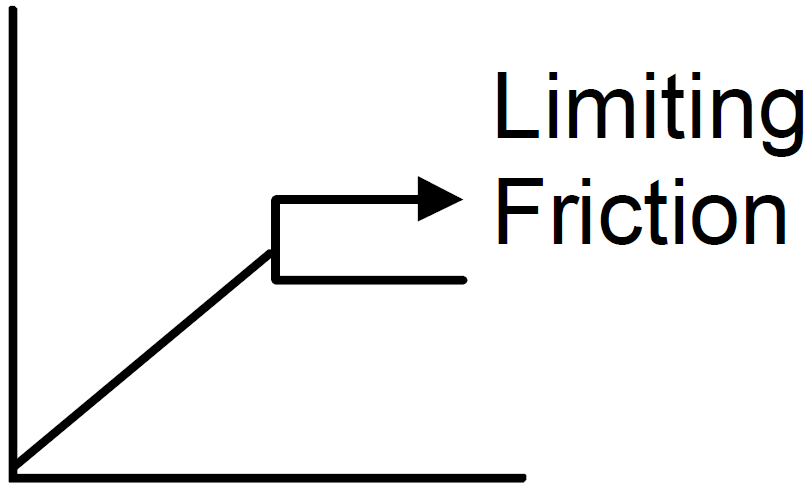
When $\text{F}=\mu\text{R, F}$ is the limiting friction (max friction). When applied force increase, force of friction increase upto limiting friction $(\mu\text{R})$
Before reaching limiting friction

$\text{F}<\mu\text{R}$
$\therefore\tan\lambda=\frac{\text{F}}{\text{R}}\leq\frac{\mu\text{R}}{\text{R}}\Rightarrow\tan\lambda\leq\mu\Rightarrow\lambda\leq\tan^{-1}\mu$

Need a full question paper?

Generate a complete, print-ready paper with questions like this in minutes — across 16+ boards, with answer keys.

Start Generating Free

Similar questions

A parallel-plate capacitor has plate area $25.0cm^2$ and a separation of 2.00mm between the plates. The capacitor is connected to a battery of 12.0V:
  1. Find the charge on the capacitor.
  2. The plate separation is decreased to 1.00mm. Find the extra charge given by the battery to the positive plate.
  1. State the principle of working of a potentiometer.
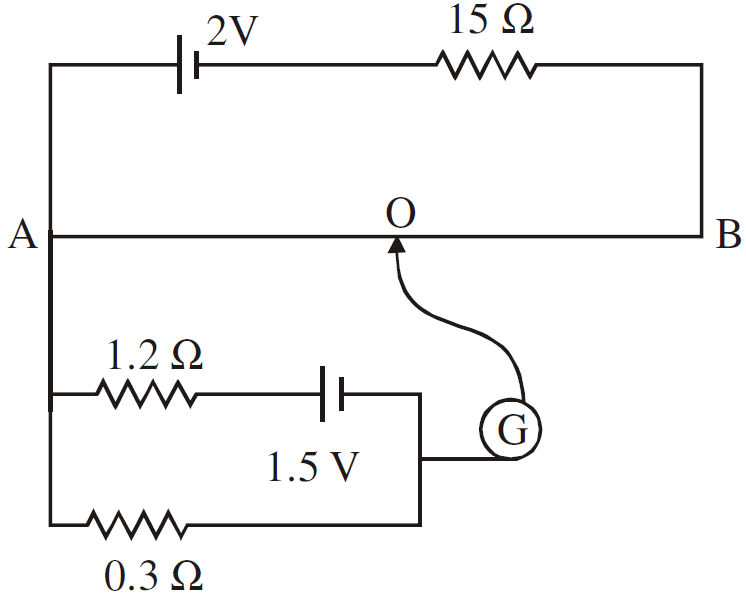
  2. In the following potentiometer circuit, AB is a uniform wire of length 1 m and resistance 10Ω. Calculate the potential gradient along the wire and balance length AO ( = l).
The gravitational attraction between electron and proton in a hydrogen atom is weaker than the coulomb attraction by a factor of about $10^{–40}$. An alternative way of looking at this fact is to estimate the radius of the first Bohr orbit of a hydrogen atom if the electron and proton were bound by gravitational attraction. You will find the answer interesting.
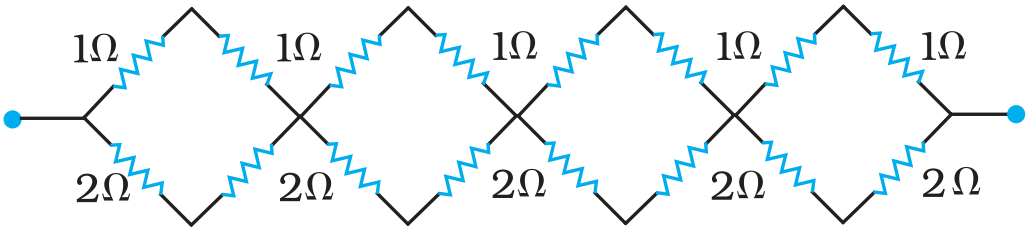
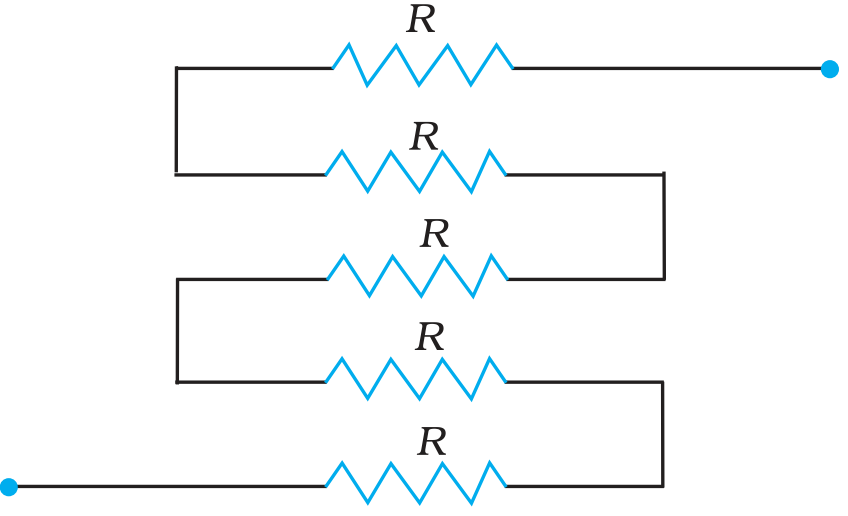
Determine the equivalent resistance of networks shown in Fig.

A convex lens of focal length 20cm and a concave lens of focal length 10cm are placed 10cm apart with their principal axes coinciding. A beam of light travelling parallel to the principal axis and having a beam diameter 5.0mm, is incident on the combination. Show that the emergent beam is parallel to the incident one. Find the beam diameter of the emergent beam.
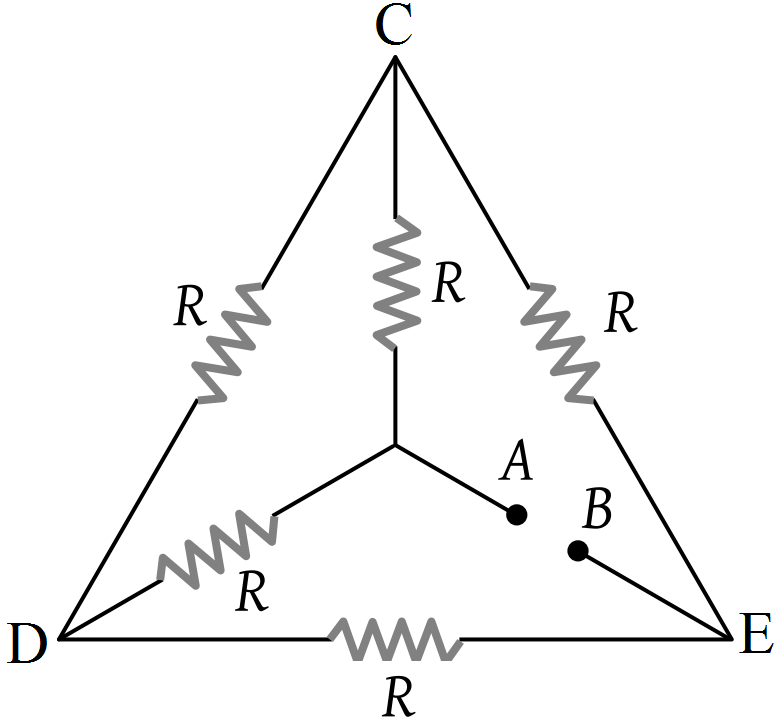
  1. Calculate the equivalent resistance of the given electrical network between points A and B.
  1. Also calculate the current through CD and ACB if a 10V dc source is connected between points A and B and the value of $\text{R}=2\Omega.$
A coil of radius 10cm and resistance $40\Omega$ has 1000 turns. It is placed with its plane vertical and its axis parallel to the magnetic meridian. The coil is connected to a galvanometer and is rotated about the vertical dimeter through an angle of 180°. Find the charge which flows through the galvanometer if the horizontal component of the earth's magnetic field is $\text{B}_{\text{H}}=3.0\times10^{-5}\text{T}.$
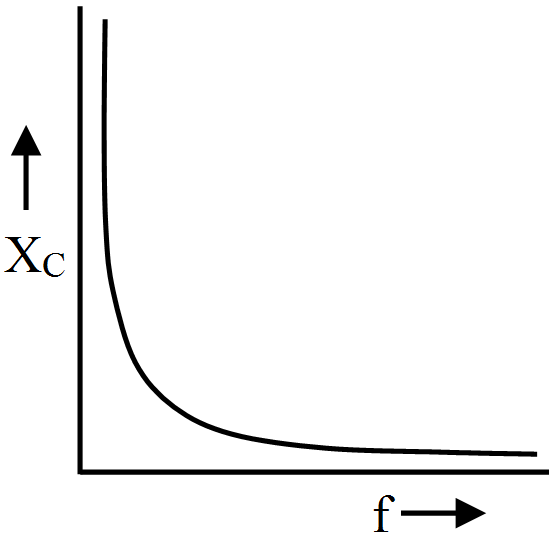
Define the term capacitive reactance. Show graphically the variation of capacitive reactance with frequency of applied alternating voltage. An ac voltage $\text{V = V}_0\sin\omega\text{t}$ is applied across a pure capacitor of capacitance C. Find an expression for current flowing through it. Show mathematically the current flowing through it leads the applied voltage by angle $\frac{\pi}{2}.$
1MW power is to be delivered from a power station to a town 10km away. One uses a pair of Cu wires of radius 0.5cm for this purpose. Calculate the fraction of ohmic losses to power transmitted if,
  1. Power is transmitted at 220V. Comment on the feasibility of doing this.
  2. A step-up transformer is used to boost the voltage to 11000V, power transmitted, then a step-down transfomer is used to bring voltage to 220V.
$(\rho_\text{Cu}1.7\times10^{-8}\text{SI unit})$.
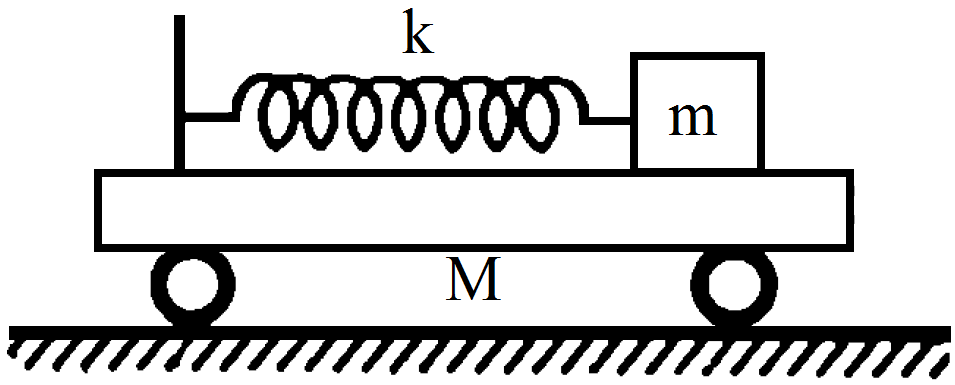
All the surfaces shown in are frictionless. The mass of the car is M, that of the block is m and the spring has spring constant k. Initially, the car and the block are at rest and the spring is stretched through a length x, when the system is released.
  1. Find the amplitudes of the simple harmonic motion of the block and of the car as seen from the road.
  2. Find the time period(s) of the two simple harmonic motions.