MCQ
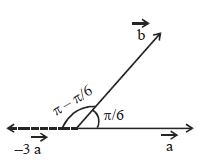
The angle between vectors $\vec a$ and $\vec b$ is $\frac{\pi }{6}$. The angle between vectors $ - 3\vec a$ and $ 2\vec b$ is
  • A
    $\frac{\pi }{3}$
  • B
    $\frac{\pi }{2}$
  • C
    $\frac{7\pi }{6}$
  • $\frac{5\pi }{6}$

Answer

Correct option: D.
$\frac{5\pi }{6}$
d

Need a full question paper?

Generate a complete, print-ready paper with questions like this in minutes — across 16+ boards, with answer keys.
Start Generating Free

Similar questions

The maximum percentage errors in the measurement of mass $(M)$, radius $(R)$ and angular velocity $(\omega)$ of a ring are $2 \%, 1 \%$ and $1 \%$ respectively, then find the maximum percentage error in the measurement of its angular momentum $(J=I \omega)$ about geometrical axis.
Select the incorrect statement about the specific heats of a gaseous system.
A sparrow flying in air sits on a stretched telegraph wire. If weight of the sparrow is $W,$ which of the following is true about the tension $T$ produced in the wire?
Work done by air when it expands from $50\, litres$ to $150\, litres$ at a constant pressure of $2$ atmosphere is
Two particles $P$ and $Q$ start from origin and execute Simple Harmonic Motion along $X-$axis with same amplitude but with periods $3$ seconds and $6$ seconds respectively. The ratio of the velocities of $ P$ and $Q$ when they meet is
The displacement $y$ (in $cm$) produced by a simple harmonic wave is $y = \frac{{10}}{\pi }\sin \left( {2000\pi t - \frac{{\pi x}}{{17}}} \right)$. The periodic time and maximum velocity of the particles in the medium will respectively be
Two resistors ${R}_{1}=(4 \pm 0.8) \Omega$ and ${R}_{2}=(4 \pm 0.4)$ $\Omega$ are connected in parallel. The equivalent resistance of their parallel combination will be
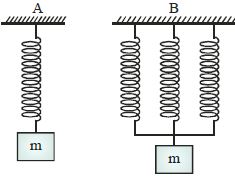
The springs in figure. $A$ and $B$ are identical but length in $A$ is three times that in $B$. The ratio of period $T_A/T_B$ is
The angle of projection at which the horizontal range and maximum height of projectile are equal is
The length of an iron wire is $L$ and area of cross-section is $A$. The increase in length is $l$ on applying the force $F$ on its two ends. Which of the statement is correct