MCQ
The angular magnification of a simple microscope can be increased by increasing
  • A
    Focal length of lens
  • B
    Size of object
  • C
    Aperture of lens
  • Power of lens

Answer

Correct option: D.
Power of lens
$m \propto \frac{1}{f} \propto P$

Need a full question paper?

Generate a complete, print-ready paper with questions like this in minutes — across 16+ boards, with answer keys.
Start Generating Free

Similar questions

A photon collides with a stationary hydrogen atom in ground state inelastically. Energy of the colliding photon is $10.2 \mathrm{eV}$. After a time interval of the order of micro second another photon collides with same hydrogen atom inelastically with an energy of $15 \mathrm{eV}$. What will be observed by the detector
A ball is thrown upwards and it returns to ground describing a parabolic path. Which of the following remains constant
The focal lengths of the objective and the eye-piece of a compound microscope are $2.0 \mathrm{~cm}$ and $3.0 \mathrm{~cm}$ respectively. The distance between the objective and the eye-piece is $15.0 \mathrm{~cm}$. The final image formed by the eye-piece is at infinity. The two lenses are thin. The distances in $\mathrm{cm}$ of the object and the image produced by the objective measured from the objective lens are respectively
A ray of light travels from an optically denser to rarer medium. The critical angle for the two media is $C$. The maximum possible deviation of the ray will be
A body of mass $6 \mathrm{~kg}$ is under a force which causes displacement in it given by $S=\frac{t^2}{4}$ metres where $t$ is time. The work done by the force in 2 seconds is
The universal property of all substances is
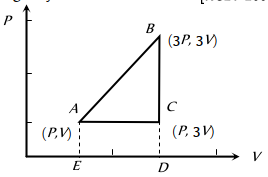
An ideal gas is taken around $\text{ABCA}$ as shown in the above $\text{P-V}$ diagram. The work done during a cycle is Image
A satellite whose mass is $M$, is revolving in circular orbit of radius $r$ around the earth. Time of revolution of satellite is
The force of gravitation is
Two particles of equal masses are revolving in circular paths of radii $r_1$ and $r_2$ respectively with the same speed. The ratio of their centripetal forces is