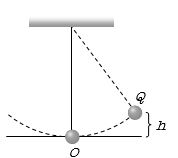
The bob of a simple pendulum is displaced from its equilibrium position $O$ to a position $Q$ which is at height h above $O$ and the bob is then released. Assuming the mass of the bob to be $m$ and time period of oscillations to be $2.0\, sec$, the tension in the string when the bob passes through $O$ is
Diffcult


Download our appand get started for free
Experience the future of education. Simply download our apps or reach out to us for more information. Let's shape the future of learning together!No signup needed.*
Similar Questions
- 1The angular velocities of three bodies in simple harmonic motion are ${\omega _1},\,{\omega _2},\,{\omega _3}$ with their respective amplitudes as ${A_1},\,{A_2},\,{A_3}$. If all the three bodies have same mass and velocity, thenView Solution
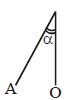
- 2Time period of a simple pendulum is $T$. The angular displacement for amplitude is $\beta$. How much time the bob of pendulum will take to move from equilibrium position $O$ to $A$, making an angle $\alpha$ at the supportView Solution
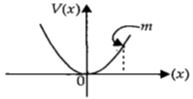
- 3A particle of mass $m$ is released from rest and follows a parabolic path as shown. Assuming that the displacement of the mass from the origin is small, which graph correctly depicts the position of the particle as a function of time $?$View Solution
- 4The graphs in figure show that a quantity $y$ varies with displacement $d$ in a system undergoing simple harmonic motion. Which graphs best represents the relationship obtained when $y$ is The total energy of the systemView Solution

- 5The amplitude of vibration of a particle is given by ${a_m} = ({a_0})/(a{\omega ^2} - b\omega + c);$ where ${a_0},a,b$ and $c$ are positive. The condition for a single resonant frequency isView Solution
- 6The frequency of oscillation of a mass $m$ suspended by a spring is $v_1$. If length of spring is cut to one third then the same mass oscillates with frequency $v_2$, thenView Solution
- 7Out of the following functions representing motion of a particle which represents $SHM$View Solution
$(A)\;y= sin\omega t-cos\omega t$
$(B)\;y=sin^3\omega t$
$(C)\;y=5cos\left( {\frac{{3\pi }}{4} - 3\omega t} \right)$
$(D)\;y=1+\omega t+{\omega ^2}{t^2}$
- 8The function of time representing a simple harmonic motion with a period of $\frac{\pi}{\omega}$ is :View Solution
- 9A particle executes simple harmonic motion according to equation $4 \frac{d^2 x}{d t^2}+320 x=0$. Its time period of oscillation is .........View Solution
- 10In $SHM,$ acceleration versus displacement (from mean position) graph :View Solution