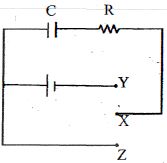
The capacitor $C$ is initially without charge.$X$ is now j oined to $Y$ for a long time, during which $H_1$ heat is produced in the resistance $R$. $X-Y$ connection is removed and $X$ is now joined to $Z$ for a long time, during which heat $H_2$ is produced in $R$.
Medium
Download our app for free and get started
Initially when $X$ is joined with $Y$ energy stored in capacitor $=$ heat proeduced $R- H_2$
When $X$ is jojned with $Z$ energy store $d$ capacitor will be lost as heat in $R$.

Download our appand get started for free
Experience the future of education. Simply download our apps or reach out to us for more information. Let's shape the future of learning together!No signup needed.*
Similar Questions
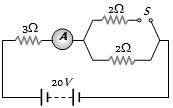
- 1In the circuit shown, the reading of ammeter when switch $S$ is open and when switch $S$ is closed respectively areView Solution
- 2A current $I$ is passing through a wire having two sections $P$ and $Q$ of uniform diameters $d$ and $d/2$ respectively. If the mean drift velocity of electrons in sections $P$ and $Q$ is denoted by $v_P$ and $v_Q$ respectively, thenView Solution
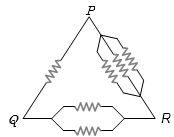
- 3Six equal resistances are connected between points $P$, $Q$ and $R$ as shown in the figure. Then the net resistance will be maximum betweenView Solution
- 4Two electric bulbs ($60\,W$ and $100\,W$ respectively) are connected in series. The current passing through them isView Solution
- 5If three bulbs $60\,W$, $100\,W$ and $200\,W$ are connected in parallel, thenView Solution
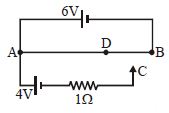
- 6A $6\, volt$ battery of negligible internal resistance resistance is connected across a uniform wire $AB$ of length $100\,cm$. The positive terminal of another battery of $emf$ $4\,V$ and internal resistance $1\,\Omega $ is joined to the point $A$ as shown in fig. Take the potential at $B$ to be zero. At which point $D$ of the wire $AB$, from left the potential is equal to the potential at $C$ ? ...................... $cm$ (approximately)View Solution
- 7Two sources of equal $emf$ are connected to an external resistance $R$. The internal resistances of the two sources are ${R_1}$ and ${R_2}\,({R_2} > {R_1})$. If the potential difference across the source having internal resistance ${R_2}$ is zero, thenView Solution
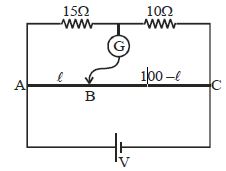
- 8In the meter bridge shown, the length $AB$ for which the deflection in galvanometer is zero will be ............. $cm$View Solution
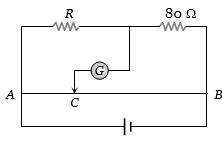
- 9$AB$ is a wire of uniform resistance. The galvanometer $G$ shows no current when the length $AC = 20\,cm$ and $CB = 80\, cm$. The resistance $R$ is equal to .............. $\Omega $View Solution
- 10Calculate the current shown by the ammeter $A$ in the circuit diagram is .............. $A$View Solution