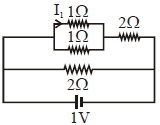
The current $I_{1}$ (in $A$) flowing through $1\; \Omega$ resistor in the following circuit is:
JEE MAIN 2020, Medium
Download our app for free and get started
Equivalent resistance of upper branch of circuit $\mathrm{R}=2.5 \Omega$
Voltage across upper branch $=1 \mathrm{V}$
$\Rightarrow \quad i=\frac{1}{2.5}=.4 \mathrm{A}$
$\Rightarrow \mathrm{I}_{1}=0.2 \mathrm{A}$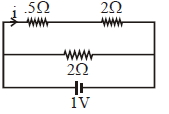

Download our appand get started for free
Experience the future of education. Simply download our apps or reach out to us for more information. Let's shape the future of learning together!No signup needed.*
Similar Questions
- 1View SolutionIn a metallic conductor, under the effect of applied electric field, the free electrons of the conductor
- 2The total current supplied to the circuit by the battery is ............. $A$View Solution
- 3View SolutionThe maximum current that flows through a fuse wire before it blows out varies with its radius as
- 4Two resistors are joined in parallel whose, resultant is $\frac{6}{5} \,\Omega$. One of the resistance wire is broken and the effective resistance becomes $2 \,ohms$. Then the resistance (in $ohm$) of the wire that got broken is ..........View Solution
- 5View SolutionA wire is broken in four equal parts. A packet is formed by keeping the four wires together. The resistance of the packet in comparison to the resistance of the wire will be
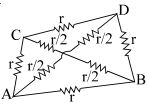
- 6The figure shows a tetrahedron, each side of which has a resistance $r$ If a battery is connected between any two points of the tetrahedron, then identify the correct statement $(s)$.View Solution
- 7If current in an electric bulb changes by $1\%$, then the power will change by ............ $\%$View Solution
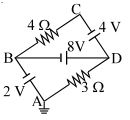
- 8The figure shows a network of resistances in which the point $A$ is earthed. The point which has the least potential isView Solution
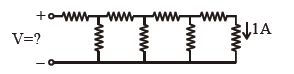
- 9Each element in the finite chain of resistors shown in the figure is $\,1\,\Omega $ . A current of $1\, A$ flows through the final element. Then what is the potential difference $V$ across input terminals of the chain .................. $\mathrm{volt}$View Solution
- 10In a meter bridge experiment resistances are connected as shown in the figure. Initially resistance $P\, = 4\,\Omega $ and the neutral point $N$ is at $60\,cm$ from $A$. Now an unknown resistance $R$ is connected in series to $P$ and the new position of the neutral point is at $80\,cm$ from $A$ . The value of unknown resistance $R$ isView Solution