MCQ
The desirable properties for making permanent magnets are:
- AHigh retentivity and high coercive force.
- BHigh retentivity and low coercive force.
- CLow retentivity and high coercive force.
- DLow retentivity and low coercive force.
Explanation:
Permanent magnetis are High retentivity and High coercive force.
Generate a complete, print-ready paper with questions like this in minutes — across 16+ boards, with answer keys.
Two point charges +9e and +e are at 16 cm away from each other. Where should another charge q be placed between them so that the system remains in equilibrium
|
(a) 24 cm from +9e |
(b) 12 cm from +9e |
(c) 24 cm from +e |
(d) 12 cm from +e |
In the circuit as shown in the figure the effective capacitance between A and B is
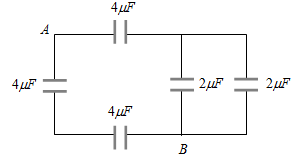
|
(a) 3 μF |
(b) 2 μF |
(c) 4 μF |
(d) 8 μF |
In the nuclear reaction  is
is
|
(a) |
(b) |
(c) |
(d) |
A wire has a resistance of 12 ohm. It is bent in the form of equilateral triangle. The effective resistance between any two corners of the triangle is
|
(a) 9 ohms |
(b) 12 ohms |
(c) 6 ohms |
(d) 8/3 ohms |
The current in a simple series circuit is 5.0 amp. When an additional resistance of 2.0 ohms is inserted, the current drops to 4.0 amp. The original resistance of the circuit in ohms was
|
(a) 1.25 |
(b) 8 |
(c) 10 |
(d) 20 |
Penetrating power of X-rays depends on
|
(a) Current flowing in the filament |
(b) Applied potential difference |
|
(c) Nature of the target |
(d) All the above |
Lenz’s law applies to
|
(a) Electrostatics |
(b) Lenses |
|
(c) Electro-magnetic induction |
(d) Cinema slides |
$\frac{\triangle\text{l}}{\text{l}}$
$\Big(\frac{\triangle\text{l}}{\text{l}}\Big)^2$
$\sqrt{\frac{\triangle\text{l}}{\text{l}}}$
None of these.
Focal length of a converging lens in air is R. If it is dipped in water of refractive index 1.33, then its focal length will be around (Refractive index of lens material is 1.5)
|
(a) R |
(b) 2R |
(c) 4R |
(d) R / 2 |


