The displacement of a particle undergoing $SHM$ of time period $T$ is given by $x(t) = x_m\,cos\, (\omega t + \phi )$. The particle is at $x = -x_m$ at time $t = 0$. The particle is at $x = + x_m$ when
AIIMS 2011, Easy


Download our appand get started for free
Experience the future of education. Simply download our apps or reach out to us for more information. Let's shape the future of learning together!No signup needed.*
Similar Questions
- 1Which of the following expressions corresponds to simple harmonic motion along a straight line, where $x$ is the displacement and $a, b, c$ are positive constants?View Solution
- 2Two masses $M_{A}$ and $M_{B}$ are hung from two strings of length $l_{A}$ and $l_{B}$ respectively. They are executing SHM with frequency relation $f_{A}=2 f_{B}$, then relationView Solution
- 3A simple pendulum of length $1\, m$ is oscillating with an angular frequency $10\, rad/s$. The support of the pendulum starts oscillating up and down with a small angular frequency of $1\, rad/s$ and an amplitude of $10^{-2}\, m$. The relative change in the angular frequency of the pendulum is best given byView Solution
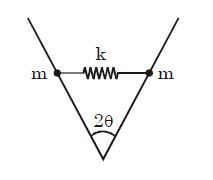
- 4Two particles of mass $m$ are constrained to move along two horizontal frictionless rails that make an angle $2\theta $ with respect to each other. They are connected by a spring with spring constant $k$ . The angular frequency of small oscillations for the motion where the two masses always stay parallel to each other (that is the distance between the meeting point of the rails and each particle is equal) isView Solution
- 5A simple pendulum hanging from the ceiling of a stationary lift has a time period $T_1$. When the lift moves downward with constant velocity, the time period is $T_2$, thenView Solution
- 6A plate oscillated with time period $‘T’$. Suddenly, another plate put on the first plate, then time periodView Solution
- 7Two springs have spring constants ${K_A}$ and ${K_B}$ and ${K_A} > {K_B}$. The work required to stretch them by same extension will beView Solution
- 8An object of mass $0.2\ kg$ executes simple harmonic along $X-$ axis with frequency of $\frac{{25}}{\pi } Hz$ . At the position $x$ = $0.04\ m$ , the object has kinetic energy of $0.5\ J$ and potential energy of $0.4\ J$ amplitude of oscillation in meter is equal toView Solution
- 9The total energy of the body executing $S.H.M.$ is $E$. Then the kinetic energy when the displacement is half of the amplitude, isView Solution
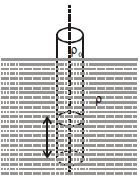
- 10A solid cylinder of density $\rho_0$, cross-section area $A$ and length $l$ floats in a liquid $\rho(> \rho_0)$ with its axis vertical, as shown. If it is slightly displaced downward and released, the time period will beView Solution