The displacement of an object attached to a spring and executing simple harmonic motion is given by $ x= 2 \times 10^{-9}$ $ cos$ $\;\pi t\left( m \right)$ .The time at which the maximum speed first occurs is
AIEEE 2007, Medium
Download our app for free and get started
Here, $x=2 \times 10^{-2} \cos \pi t$
$\therefore v=\frac{d x}{d t}=2 \times 10^{-2} \pi \sin \pi t$
For the first time, the speed to be maximum,
$\sin \pi t=1$ or, $\sin \pi t=\sin \frac{\pi}{2}$
$\Rightarrow \pi t=\frac{\pi}{2} \quad$ or, $t=\frac{1}{2}=0.5 \mathrm{sec}$

Download our appand get started for free
Experience the future of education. Simply download our apps or reach out to us for more information. Let's shape the future of learning together!No signup needed.*
Similar Questions
- 1The variation of kinetic energy $(KE)$ of a particle executing simple harmonic motion with the displacement $(x)$ starting from mean position to extreme position $(A)$ is given byView Solution
- 2If two similar springs each of spring constant $K _{1}$ are joined in series, the new spring constant and time period would be changed by a factorView Solution
- 3If a simple pendulum oscillates with an amplitude of $50\, mm$ and time period of $2\, sec$, then its maximum velocity is .... $m/s$View Solution
- 4The instantaneous displacement of a simple pendulum oscillator is given by $x = A\,\cos \,\left( {\omega t + \frac{\pi }{4}} \right)$ . Its speed will be maximum at timeView Solution
- 5A block of mass m, attached to a spring of spring constant $k$, oscillates on a smooth horizontal table. The other end of the spring is fixed to a wall. The block has a speed $v$ when the spring is at its natural length. Before coming to an instantaneous rest, if the block moves a distance $x$ from the mean position, thenView Solution
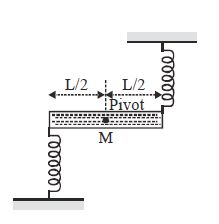
- 6A uniform stick of mass $M$ and length $L$ is pivoted at its centre. Its ends are tied to two springs each of force constant $K$ . In the position shown in figure, the strings are in their natural length. When the stick is displaced through a small angle $\theta $ and released. The stickView Solution
- 7A particle is placed at the lowest point of a smooth wire frame in the shape of a parabola, lying in the vertical $xy-$ plane having equation $x^2 = 5y$ $(x, y$ are in meter). After slight displacement, the particle is set free. Find angular frequency of oscillation.....$rad/s$ (in $rad/sec$ ) (take $g = 10\ m/s^2$ )View Solution
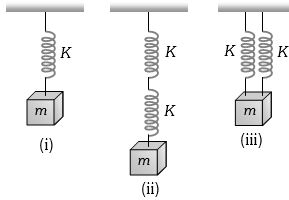
- 8View SolutionFive identical springs are used in the following three configurations. The time periods of vertical oscillations in configurations (i), (ii) and (iii) are in the ratio
- 9The period of oscillation of a mass $M$ suspended from a spring of negligible mass is $T$. If along with it another mass $M$ is also suspended, the period of oscillation will now beView Solution
- 10The average speed of the bob of a simple pendulum oscillating with a small amplitude $A$ and time period $T$ isView Solution