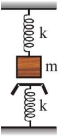
A block of mass m, attached to a spring of spring constant $k$, oscillates on a smooth horizontal table. The other end of the spring is fixed to a wall. The block has a speed $v$ when the spring is at its natural length. Before coming to an instantaneous rest, if the block moves a distance $x$ from the mean position, then
Easy


Download our appand get started for free
Experience the future of education. Simply download our apps or reach out to us for more information. Let's shape the future of learning together!No signup needed.*
Similar Questions
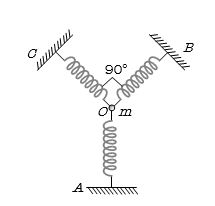
- 1A particle of mass $m$ is attached to three identical springs $A, B$ and $C$ each of force constant $ k$ a shown in figure. If the particle of mass $m$ is pushed slightly against the spring $A$ and released then the time period of oscillations isView Solution
- 2A person of mass $M$ is, sitting on a swing of length $L$ and swinging with an angular amplitude $\theta_0$. If the person stands up when the swing passes through its lowest point, the work done by him, assuming that his centre of mass moves by a distance $l\, ( l < < L)$, is close toView Solution
- 3A block of mass $1 \,kg$ attached to a spring is made to oscillate with an initial amplitude of $12\, cm$. After $2\, minutes$ the amplitude decreases to $6\, cm$. Determine the value of the damping constant for this motion. (take In $2=0.693$ )View Solution
- 4Values of the acceleration $A$ of a particle moving in simple harmonic motion as a function of its displacement $x$ are given in the table below. The period of the motion isView Solution
$A (mm \,\,s^{-2}$) $16$
$8$
$0$
$- 8$
$- 16$
$x\;(mm)$
$- 4$
$- 2$
$0$
$2$
$4$
- 5View SolutionA simple pendulum is vibrating in an evacuated chamber, it will oscillate with
- 6The maximum speed of a particle executing $S.H.M.$ is $1\,m/s$ and its maximum acceleration is $1.57\,m/se{c^2}$. The time period of the particle will be .... $\sec$View Solution
- 7View SolutionTo make the frequency double of an oscillator, we have to
- 8View SolutionA simple pendulum is vibrating in an evacuated chamber, it will oscillate with
- 9Vertical displacement of a plank with a body of mass $'m'$ on it is varying according to law $y = \sin \omega t + \cos \omega t.$ The minimum value of $\omega $ for which the mass just breaks off the plank and the moment it occurs first after $t = 0$ are given by : ( $y$ is positive vertically upwards)View Solution
- 10A mass $m$ is suspended from a spring of force constant $k$ and just touches another identical spring fixed to the floor as shown in the figure. The time period of small oscillations isView Solution