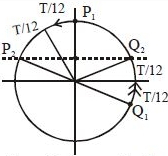
Two particles are executing $SHM$ in a straight line. Amplitude $'A'$ and time period $'T'$ of both the particles are equal. At time $t = 0$ one particle is at displacement $x_1 = +A$ and other at ${x_2} = \frac{{ - A}}{2}$ and they are approaching towards each other. Time after which they will cross each other is
Advanced


Download our appand get started for free
Experience the future of education. Simply download our apps or reach out to us for more information. Let's shape the future of learning together!No signup needed.*
Similar Questions
- 1The $S.H.M.$ of a particle is given by the equations $=2 \sin \omega t+4 \cos \omega t$. Its amplitude of oscillation is ........ unitsView Solution
- 2A body is executing Simple Harmonic Motion. At a displacement $x$ its potential energy is ${E_1}$ and at a displacement y its potential energy is ${E_2}$. The potential energy $E$ at displacement $(x + y)$ isView Solution
- 3View SolutionIn a simple harmonic oscillator, at the mean position
- 4The function of time representing a simple harmonic motion with a period of $\frac{\pi}{\omega}$ is :View Solution
- 5If $A$ is the area of cross-section of a spring $L$ is its length $E$ is the Young's modulus of the material of the spring then time period and force constant of the spring will be respectivelyView Solution
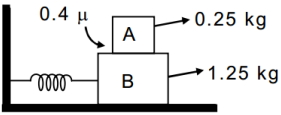
- 6The length of a simple pendulum is increased by $1\%$. Its time period willView Solution
- 7View SolutionWhich of the following function represents a simple harmonic oscillation
- 8The motion of a particle represented by $y\ =$ $\sin \omega t - \cos \omega t$ isView Solution
- 9A particle is executing simple harmonic motion with a time period $T.$ At time $t = 0$, it is at its position of equilibrium. The kinetic energy-time graph of the particle will look likeView Solution
- 10Maximum amplitude(in $cm$) of $SHM$ so block A will not slip on block $B , K =100 N / m$View Solution