MCQ
The Einstein’s photo$-$electric equation is based upon the conservation of:
  • A
    Mass
  • B
    Momentum
  • C
    Angular momentum
  • Energy

Answer

Correct option: D.
Energy

Einsteins photoelectric equations states that
$E_k$ ​= hν − $\phi$
where, $E_k$​ is maximum kinetic energy of emitted photoelectrons
$h$ is plank's constant.
$ν$ is frequency of incident light
$\phi$ is work function of metal.
So, it is clearly based upon energy conservation.

Need a full question paper?

Generate a complete, print-ready paper with questions like this in minutes — across 16+ boards, with answer keys.
Start Generating Free

Similar questions

The phase difference between input and output voltages of a $\ce{CE}$ circuit is
During a nuclear fission reaction:
A solid conducting sphere, having a charge $Q$, is surrounded by an uncharged conducting hollow spherical shell. Let the potential difference between the surface of the solid sphere and that of the outer surface of the hollow shell be $V$. If the shell is now given a charge of $-4\, Q$, the new potential difference between the same two surface is......$V$
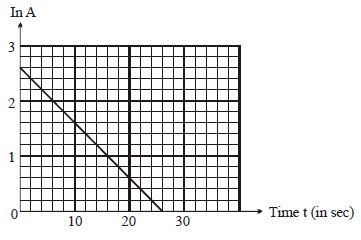
The graph in figure shows how the count-rate $A$ of a radioactive source as measured by a Geiger counter varies with time $t.$ The relationship between $A$ and $t$ is : $($ Assume $ln\,\, 12 = 2.6)$
In a young's double slit experiment, the fringe pattern is observed on a screen placed at a distance $D$. The slits are separated by $d$ and are illuminated by light of wavelength $\lambda$. Find the distance from the central point where the intensity falls  to half the maximum is 
A $10\,\mu F$ capacitor is charged to a potential difference of $1000\, V$. The terminals of the charged capacitor are disconnected from the power supply and connected to the terminals of an uncharged $6\, \mu F$ capacitor. What is the final potential difference across each capacitor?......$V$
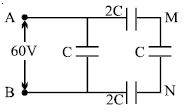
In the circuit shown, a potential difference of $60\,V$ is applied across $AB$. The potential difference between the point $M$ and $N$ is.....$V$
The angle of a prism is $A$. One of its refracting surfaces is silvered. Light rays falling at an angle of incidence $2A$ on the first surface returns back through the same path after suffering reflection at the silvered surface. The refractive index $\mu$, of the prism is
Fission of nuclei is possible because the binding energy per nucleon in them
The Cauchy’s dispersion formula is