The electric current passing through a metallic wire produces heat because of
Easy


Download our appand get started for free
Experience the future of education. Simply download our apps or reach out to us for more information. Let's shape the future of learning together!No signup needed.*
Similar Questions
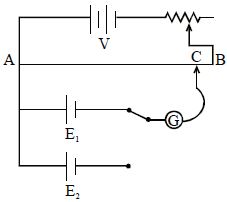
- 1The circuit shown here is used to compare the emf of two cells $E_1$ and $E_2 (E_1 > E_2)$. The null point is at $C$ when the galvanometer is connected to $E_1$. When the galvanometer is connected to $E_2$, the null point will beView Solution
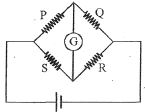
- 2Resistances are arranged in a cyclic order to form a balanced wheatstone bridge as shown in figure. Ratio of power consumed in the branches $P + Q$ and $R + S$ isView Solution
- 3A battery of internal resistance one ohm and $emf$ $3\,volt$ sends a current through $1\,metre$ of uniform wire of resistance $5\,\Omega $. The pole of the cell of $emf$ $1.4\,volt$ are connected to two points on the wire so that no current passes through this cell. Then, the potential gradient of the wire isView Solution
- 4Three resistors of $4\,\Omega ,6\,\Omega $ and $12\,\Omega $ are connected in parallel and the combination is connected in series with a $1.5\, V$ battery of $1\,\Omega $ internal resistance. The rate of Joule heating in the $4\,\Omega $ resistor is ................ $W$View Solution
- 5A ($100\, W$, $200\, V$) bulb is connected to a $160\, V$ power supply. The power consumption would be ............. $W$View Solution
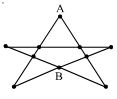
- 6The resistance of all the wires between any two adjacent dots is $R$. Then equivalent resistance between $A$ and $B$ as shown in figure is :View Solution
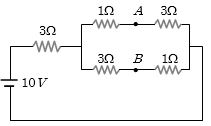
- 7A battery of $e.m.f.$ $10\, V$ is connected to resistance as shown in figure. The potential difference ${V_A} - {V_B}$ between the points $A$ and $B$ is .................... $V$View Solution
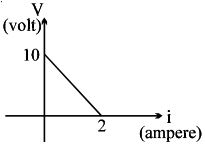
- 8$A$ battery of $\mathrm{emf}$ $E$ and internal resistance $r$ is connected across a resistance $R$. Resistance $R$ can be adjusted to any value greater than or equal to zero. Agraph is plotted between the current $(i)$ passing through the resistance and potential difference $(V) $ across it. Select the correct alternative $(s)$.View Solution
- 9Two metal wires of identical dimensions are connected in series. If $\sigma _1$ and $\sigma _2$ are the conductivities of the metal wires respectively, the effective conductivity of the combination isView Solution
- 10Which of the following graph represents the variation of resistivity ( $\rho$ ) with temperature $(T)$ for copper $?$View Solution