MCQ
The electromagnetic waves travel with a velocity
  • A
    Equal to velocity of sound
  • Equal to velocity of light
  • C
    Less than velocity of light
  • D
    None of these

Answer

Correct option: B.
Equal to velocity of light
b
(b) Velocity of $EM$ waves =$\frac{1}{{\sqrt {{\mu _0}{ \in _0}} }}3 \times {10^8}m/s$ = velocity of light

Need a full question paper?

Generate a complete, print-ready paper with questions like this in minutes — across 16+ boards, with answer keys.

Start Generating Free

Similar questions

A proton and an alpha particle of the same enter in a uniform magnetic field which is acting perpendicular to their direction of motion. The ratio of the circular paths described by the alpha particle and proton is ....
Let p and E denote the linear momentum and the energy of a photon. For another photon of smaller wavelength $($in same medium$):$
Current $i$ is passed as shown in diagram. If radius of the circle is a, then the magnetic flux density at the centre $P$ will be:
The capacitance of an air capacitor is $15\,\mu F$ the separation between the parallel plates is $6\,mm$. A copper plate of $3\,mm$ thickness is introduced symmetrically between the plates. The capacitance now becomes.........$\mu F$
The equivalent capacitance of three capacitors of capacitance ${C_1},{C_2}$ and ${C_3}$ are connected in parallel is $12$ units and product ${C_1}.{C_2}.{C_3} = 48$. When the capacitors ${C_1}$ and ${C_2}$ are connected in parallel, the equivalent capacitance is $6$ units. Then the capacitance are
In an electromagnetic wave.
A parallel plate condenser is immersed in an oil of dielectric constant $2$. The field between the plates is
The atomic mass of ${ }_T N ^{15}$ is $15.000108$ a.m.u. and that of ${ }_8 O ^{16}$ is $15.994915$ a.m.u. If the mass of a proton is $1.007825$ a.m.u. then the minimum energy provided to remove the least tightly bound proton is ......... $MeV$
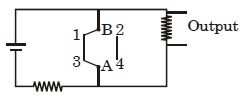
Switch $B$ can rest at either $1$ or $2$ as well as switch $A$ can rest at either $3$ or $4$ then output will be 
The shortest wavelength of Lyman series of hydrogen atom is equal to the shortest  wavelength of Balmer series of an hydrogen like atom of atomic number $Z$. The value of $Z$ is equal to :-