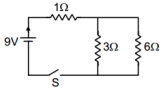
The energy consumed in $1\, Kwatt$ electric heater in $30$ seconds will be
Easy


Download our appand get started for free
Experience the future of education. Simply download our apps or reach out to us for more information. Let's shape the future of learning together!No signup needed.*
Similar Questions
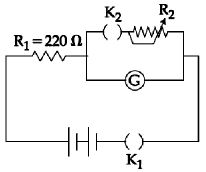
- 1The galvanometer deflection, when key $K_1$ is closed but $K_2$ is open, equals $\theta_0$ (see figure). On closing $K_2$ also and adjusting $R_2$ to $5\,\Omega $ , the deflection in galvanometer becomes $\frac{{\theta _0}}{5}$. The resistance of the galvanometer is, then, given by [Neglect the internal resistance of battery]: .................. $\Omega$View Solution
- 2The length of a wire of a potentiometer is $100\, cm$, and the $emf$ of its standard cell is $E\,volt$. It is employed to measure the $e.m.f$ of a battery whose internal resistance is $0.5 \,\Omega$. If the balance point is obtained at $l = 30\, cm$ from the positive end, the $e.m.f.$ of the battery isView Solution
where $i$ is the current in the potentiometer
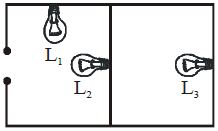
- 3Figure shows three similar lamps $L_1, L_2$ and $L_3$ connected across a power supply. If the lamp $L_3$ fuses, how will the light emitted by $L_1$ and $L_2$ change ?View Solution
- 4A potentiometer is an accurate and versatile device to make electrical measurements of $EMF$ because the method involvesView Solution
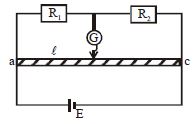
- 5Fig. shows rough sketch of meter bridge. $(G)$ deflects zero at length $\ell \, cm$. Now $R_1$ and $R_2$ are interchanged then balancing length increases by $25\, cm$. Find $R_1/R_2$View Solution
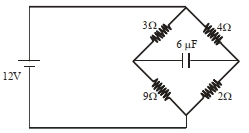
- 6In the circuit shown, the energy stored in the capacitor is $n\,\mu J$. The value of $n$ is ..............View Solution
- 7Assertion : The current density $\vec J$ at any point in ohmic resistor is in direction of electric field $\vec E$ at that point.View Solution
Reason : A point charge when released from rest in a region having only electrostatic field always moves along electric lines of force.
- 8A uniform metallic wire has a resistance of $18\,\Omega $ and is bent into an equilateral triangle. Then, the resistance between any two vertices of the triangle is .................. $\Omega$View Solution
- 9After switch is closed, current drawn from the battery is (in $A$)View Solution
- 10In an experiment to find $emf$ of a cell using potentiometer, the length of null point for a cell of emf $1.5\,V$ is found to be $60\,cm$. If this cell is replaced by another cell of $emf\; E$. the length-of null point increases by $40\,cm$. The value of $E$ is $\frac{x}{10} V$. The value of $x$ is $............$View Solution