The equation of $SHM$ of a particle is given as
$2\,\frac{{{d^2}x}}{{d{t^2}}} + 32x = 0$
where $x$ is the displacement from the mean position of rest. The period of its oscillation (in seconds) is
Diffcult
Download our app for free and get started
The given equation of $SHM$ is,
$2 \frac{\mathrm{d}^{2} \mathrm{x}}{\mathrm{dt}^{2}}+32 \mathrm{x}=0 \quad \mathrm{OR}$
$\frac{d^{2} x}{d t^{2}}+\frac{32}{2} x=0$
$\frac{d^{2} x}{d t^{2}}=-16 x$ $...(i)$
The standard equation of $SHM$ is,
$\frac{d^{2} x}{d t^{2}}=-\omega^{2} x$ $...(ii)$
Comparing equation, $(i)$ and $(ii),$ we get
$\omega^{2}=16 \quad \mathrm{OR}$ $\omega=4$
The period, $T=\frac{2 \pi}{\omega}=\frac{2 \pi}{4}=\frac{\pi}{2} \mathrm{s}$

Download our appand get started for free
Experience the future of education. Simply download our apps or reach out to us for more information. Let's shape the future of learning together!No signup needed.*
Similar Questions
- 1Two simple harmonic motions are represented by equations ${y_1} = 4\,\sin \,\left( {10t + \phi } \right)$ and ${y_2} = 5\,\cos \,10\,t$ What is the phase difference between their velocities?View Solution
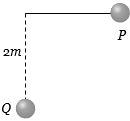
- 2A pendulum of length $2\,m$ lift at $P$. When it reaches $Q$, it losses $10\%$ of its total energy due to air resistance. The velocity at $Q$ is .... $m/sec$View Solution
- 3${T}_{0}$ is the time period of a simple pendulum at a place. If the length of the pendulum is reduced to $\frac{1}{16}$ times of its initial value, the modified timeView Solution
- 4View SolutionResonance is an example of
- 5A brass cube of side $a$ and density $\rho$ is floating in mercury of density $\sigma$. If the cube is displaced a bit vertically, it executes $S.H.M.$ Its time period will beView Solution
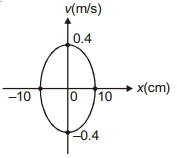
- 6The plot of velocity $(v)$ versus displacement $(x)$ of a particle executing simple harmonic motion is shown in figure. The time period of oscillation of particle is .........View Solution
- 7Due to some force $F_1$ a body oscillates with period $4/5\, sec$ and due to other force $F_2$ oscillates with period $3/5\, sec$. If both forces act simultaneously, the new period will be .... $\sec$View Solution
- 8A particle of mass $m$ executes simple harmonic motion with amplitude $a$ and frequency $v$. The average kinetic energy during its motion from the position of equilibrium to the end isView Solution
- 9A particle of mass $m$ oscillates with simple harmonic motion between points ${x_1}$ and ${x_2}$, the equilibrium position being $O$. Its potential energy is plotted. It will be as given below in the graphView Solution
- 10An ideal spring with spring-constant $K$ is hung from the ceiling and a block of mass $M$ is attached to its lower end. The mass is released with the spring initially unstretched. Then the maximum extension in the spring isView Solution