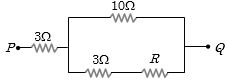
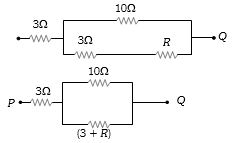
In the circuit shown here, what is the value of the unknown resistor $R$ so that the total resistance of the circuit between points $P$ and $Q$ is also equal to $R$
Medium


Download our appand get started for free
Experience the future of education. Simply download our apps or reach out to us for more information. Let's shape the future of learning together!No signup needed.*
Similar Questions
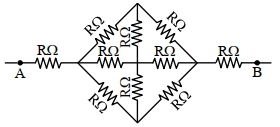
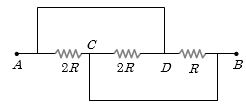
- 1The effective resistance between $A$ and $B$, if resistance of each resistor is $R$, will beView Solution
- 2A potentiometer circuit has been set up for finding the internal resistance of a given cell. The main battery, used across the potentiometer wire, has an emf of $2.0\,V$ and a negligible internal resistance. The potentiometer wire itself is $4\,m$ long. When the resistance $R,$ connected across the given cell, has values of $(i)$ infinity $(ii)$ $9.5\,\Omega$ the balancing lengths on the potentiometer wire are found to be $3\,m$ and $2.85\,m,$ respectively. The value of internal resistance of the cell is ............... $\Omega$View Solution
- 3What is the equivalent resistance between $A$ and $B$View Solution
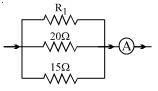
- 4In the given circuit the current flowing through the resisitance $20$ $\mathrm{ohms}$ is $0.3$ $\mathrm{ampere}$ while the ammeter reads $0.8$ $\mathrm{ampere}.$ What is the value of $R_1$? ................ $\mathrm{ohm}$View Solution
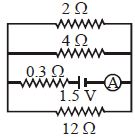
- 5In the circuit shown in the adjoining figure, the reading of ammeter $A$ is ................ $\mathrm{A}$View Solution
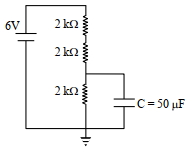
- 6A capacitor of $50 \,\mu {F}$ is connected in a circuit as shown in figure. The charge on the upper plate of the capacitor is $......\,\mu {C} .$View Solution
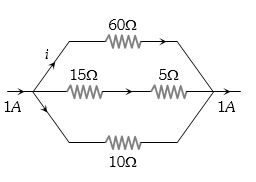
- 7The magnitude of $i$ in ampere unit isView Solution
- 8When current supplied by a cell to a circuit is $0.3 \,A$, its terminal potential difference is $0.9 \,V$. When the current supplied becomes $0.25 \,A$, its terminal potential difference becomes $1.0 \,V$. The internal resistance of the cell is ............ $\Omega$View Solution
- 9View SolutionIf a high power heater is connected to electric mains, then the bulbs in the house become dim, because there is a
- 10The capacitor $C$ is initially without charge.$X$ is now j oined to $Y$ for a long time, during which $H_1$ heat is produced in the resistance $R$. $X-Y$ connection is removed and $X$ is now joined to $Z$ for a long time, during which heat $H_2$ is produced in $R$.View Solution