MCQ
The flow of the electric current through a metallic conductor is:
  • A
    Only due to electrons
  • B
    Only due to + ve charges
  • C
    Due to both nuclei and electrons.
  • D
    Can not be predicted.

Answer

  1. Only due to electrons

Explanation:

Protons and neutrons are strongly bound to the atoms (in the nucleus).

Only electrons can be free from atoms.

The systematic flow of these free electrons constitutes a current.

Therefore, the electric current is only due to the flow of electrons.

Need a full question paper?

Generate a complete, print-ready paper with questions like this in minutes — across 16+ boards, with answer keys.
Start Generating Free

Similar questions

The energy in the reactor of a nuclear power station is produced by the process of:
  1. Nuclear diffusion.
  2. Nuclear fission.
  3. Nuclear fusion.
  4. Nuclear fermentation.
Choose the incorrect statement:
  1. Fleming’s right-hand rule is a simple rule to know the direction of induced current.
  2. The right-hand thumb rule is used to find the direction of magnetic fields due to current carrying conductors.
  3. The difference between the direct and alternating currents is that the direct current always flows in one direction, whereas the alternating current reverses its direction periodically.
  4. In India, the AC changes direction after every $\frac{1}{50}$ second.
An induced current is produced when a magnet is moved into a coil. The magnitude of induced current does not depend on:
  1. The speed with which the magnet is moved.
  2. The number of turns of the coil.
  3. The resistivity of the wire of the coil.
  4. The strength of the magnet.
The steps involved in observing a slide under a microscope are given below. They may not be in proper sequence.

  1. Focus the object under high power of the microscope.

  2. Place the slide on the stage of the microscope.

  3. Arrange the mirror to reflect maximum light to the slide.

  4. Focus the object under low power of the microscope.

The proper sequence of steps is:
Name the colour used in insulated wires of electrical appliance:
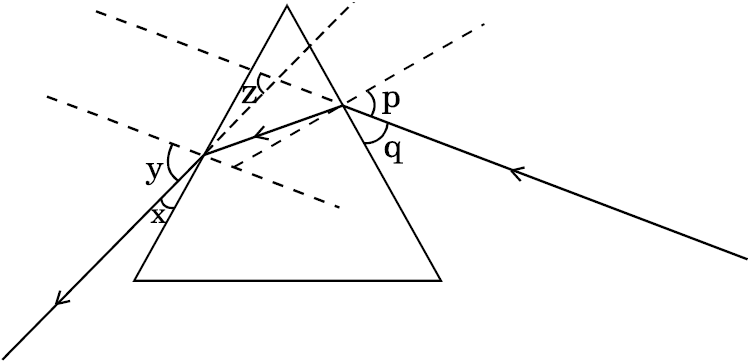
Study the following ray diagram:

In this diagram, the angle of incidence, the angle of emergence and the angle of deviation respectively have been represented by.
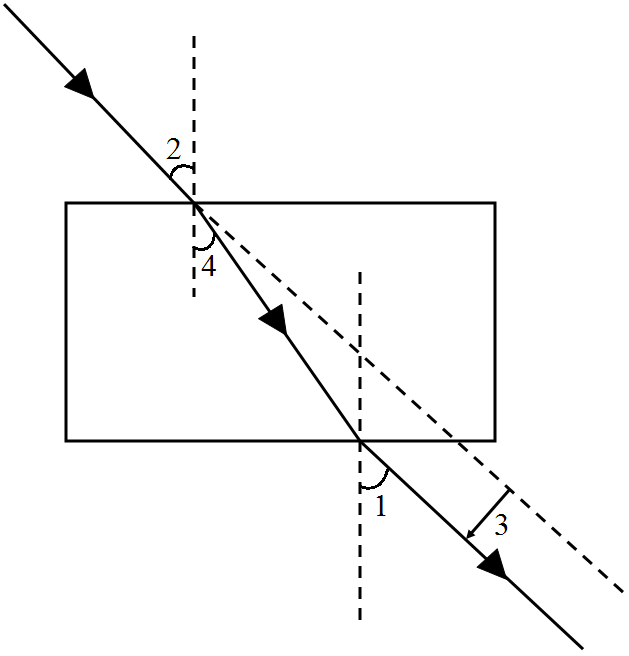
The correct sequencing of angle of incidence, angle of emergence, angle of refraction and lateral displacement shown in the following diagram by digits 1, 2, 3 and 4 is:
The mirror used by a dentist to examine the teeth of a person is:
  1. Convex.
  2. Concave.
  3. Plane.
  4. Any one of the above.
A student obtained a sharp inverted image of a distant tree on a screen placed in front of the concave mirror. He then removed the screen and tried to look into the mirror. He would now see
The device used for measuring potential difference is known as: