Question
The following graph represents the organismic response to certain environmental condition (e.g. temperature):
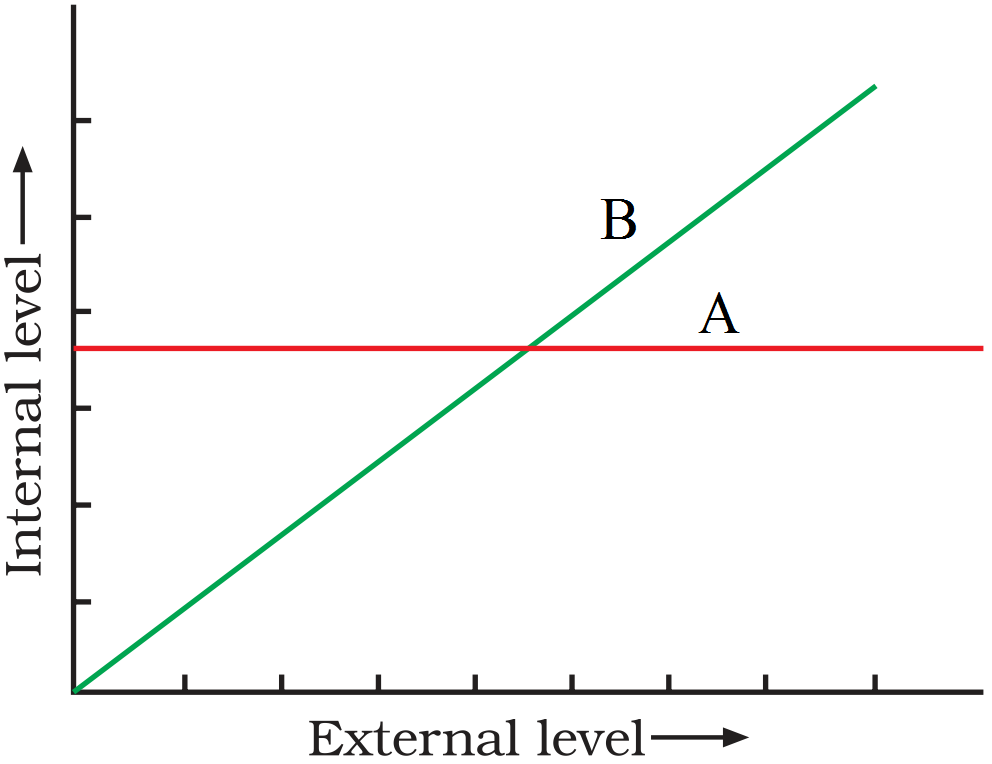
  1. Which one of these, 'a' or 'b', depicts conformers?
  2. What does the other line graph depict?
  3. How do these organisms differ from each other with reference to homeostasis?
  4. Mention the category to which humans belong.

Answer

  1. 'a' depicts conformers.
  2. The other line 'b' depicts regulaters.
  3.  
  Conformers   Regulators
1 These are the organisms, which cannot maintain a constant internal environment and change according to the ambient atmospheric conditions 1 These are the organisms which maintain a constant internal environment despite changes in the environment.
2 They show a narrow range of distribution. 2 They show a much wider range of distribution.
  1. Humans are regulaters.

Need a full question paper?

Generate a complete, print-ready paper with questions like this in minutes — across 16+ boards, with answer keys.

Start Generating Free

Similar questions

Explain enzyme-replacement therapy to treat adenosine deaminase deficiency. Mention two disadvantages of this procedure.
Answer the following questions:
Give two reasons why Mendel selected garden pea for his experiments. Give the biological name of this plant.
  1. What is an ‘allergic reaction’?
  2. Name any two drugs used to quickly reduce the symptoms of allergy.
  3. Why do more and more children in metro cities of India suffer from allergies and asthma?
Identify A, B, C and D in the table given below:
Micro-organism
Product
Biological activity
Medical ailment/ Procedure
A
Streptokinase
Clot buster
D
Trichoderma
B
C
Transplant
Polysporum
 
 
Surgery
Pollen banks are playing a very important role in promoting plant breeding programme the world over. How are pollens preserved in the pollen banks? Explain. How are such banks benefitting our farmer? Write any two ways.
Describe three manners in which fertilisation of human ovum by a sperm can be prevented.
In a Polymerase Chain Reaction (PCR), give the temperature required for the steps:
  1. Denaturation.
  2. Annealing.
  3. Extension, respectively.
Suggest and describe a technique to obtain multiple copies of a gene of interest in vitro.
  1. State how the constant internal environment is beneficial to organisms.
  2. Explain any two alternatives by which organisms can overcome stressful external conditions.
  1. Define pioneer species.
  2. Among bryophytes, lichens and fern, which one is a pioneer species in a xeric succession? And why?