Question
The general solution of the $D E x^2 \frac{d y}{d x}=x^2+x y+y^2$ is

Answer

(a) $\tan ^{-1} \frac{y}{x}=\log x+C$
Explanation: We have,
$x^2 \frac{d y}{d z}=x^2+x y+y^2$
$\frac{d y}{d x}=1+\frac{y}{x}+\frac{y^2}{x^2}$Let $y = vx$
$\frac{d y}{d x}=v+x \frac{d v}{d x}$
$1+v+v^2=v+x \frac{d v}{d x}$
$1+v^2=x \frac{d v}{d x}$
$\frac{d x}{x}=\frac{d v}{v^2+1}$
On integrating on both sides, we obtain
$\log x=\tan ^{-1} v+C$
$\tan ^{-1} \frac{y}{x}=\log x+c$

Need a full question paper?

Generate a complete, print-ready paper with questions like this in minutes — across 16+ boards, with answer keys.
Start Generating Free

Similar questions

  Evaluate $\begin{bmatrix}4&8&12\\6&12&18\\7&14&21\end{bmatrix}$ is:
  1. 168
  2. -1
  3. -168
  4. 0
If $A=\left[\begin{array}{ll}5 & x \\ y & 0\end{array}\right]$ and $A=A^T$, where $A^T$ is the transpose of the matrix $A$, then
Which of the following differentials equation has y = x as one of its particular solution?
  1. $\frac{\text{d}^{2}\text{y}}{\text{dx}^{2}}-\text{x}^{2}\frac{\text{dy}}{\text{dx}}+\text{xy}=\text{x}$
  2. $\frac{\text{d}^{2}\text{y}}{\text{dx}^{2}}+\text{x}^{2}\frac{\text{dy}}{\text{dx}}+\text{xy}=\text{x}$
  3. $\frac{\text{d}^{2}\text{y}}{\text{dx}^{2}}-\text{x}^{2}\frac{\text{dy}}{\text{dx}}+\text{xy}=\text{0}$
  4. $\frac{\text{d}^{2}\text{y}}{\text{dx}^{2}}+\text{x}^{2}\frac{\text{dy}}{\text{dx}}+\text{xy}=\text{0}$
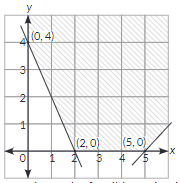
A linear programming problem (LPP) along with the graph of its constraints is shown below. The corresponding objective function is
Minimize: $Z=3 x+2 y$. The minimum value of the objective function is obtained at the corner point ( 2 , 0).
The optimal solution of the above linear programming problem $\qquad$
Image
A random variable has the following probability distribution:
$X = x_i$ $0$ $1$ $2$ $3$ $4$ $5$ $6$ $7$
$P(X = X_i)$ $0$ $2p$ $2p$ $3p$ $p^2$ $2p^2$ $7p^2$ $2p$
If a matrix $A=\left[\begin{array}{lll}1 & 2 & 3\end{array}\right]$, then the matrix $A A^{\prime}\  ($where $A^{\prime}$ is the transpose of $A )$ is
The matrix $A=\left[\begin{array}{ll}0 & 1 \\ 1 & 0\end{array}\right]$ is a
Choose the correct answer from the given four option.
Solution of the differential equation $\tan\text{y}\sec^2\text{xdx} + \tan\text{x }\sec^2\text{ydy}=0$is:
  1. $\tan\text{x}+\tan\text{y}=\text{k}$
  2. $\tan\text{x}-\tan\text{y}=\text{k}$
  3. $\frac{\tan\text{x}}{\tan\text{y}}=\text{k}$
  4. $\tan\text{x}.\tan\text{y}=\text{k}$
Direction cosines of the line $\frac{x-1}{2}=\frac{1-y}{3}=\frac{2 z-1}{12}$ are:
If $\frac{\text{dy}}{\text{dx}}=\frac{1}{\text{x}}$ then y =
  1. $\text{ln }\text{x}+\text{c}$
  2. $\text{x}+\text{c}$
  3. $\frac{-1}{\text{x}^2}+\text{c}$
  4. $\frac{1}{\text{x}^2}+\text{c}$