What is immaterial for an electric fuse wire
Easy
Download our app for free and get started
(c) Length is immaterial for an electric fuse wire.

Download our appand get started for free
Experience the future of education. Simply download our apps or reach out to us for more information. Let's shape the future of learning together!No signup needed.*
Similar Questions
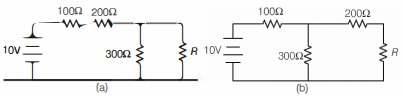
- 1A student was trying to construct the circuit shown in the figure below marked $(a)$, but ended up constructing the circuit marked $(b)$. Realising her mistake, she corrected the circuit, but to her surprise, the output voltage (across $R$ ) did not change. The value of resistance $R$ is ............ $\Omega$View Solution
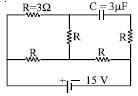
- 2In the circuit shown, the cell is ideal, with $emf$ $=$ $15$ $V$. Each resistance is of $3 $ $\Omega$ . The potential difference across the capacitor is.....$V$View Solution
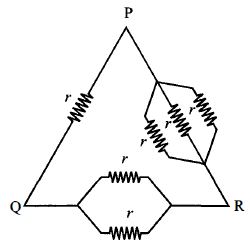
- 3Six equal resistances are connected between points $P, Q$ and $R$ as shown in figure. Then net resistance will be maximum betweenView Solution
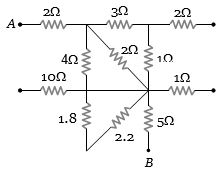
- 4What is the equivalent resistance between the points $A$ and $B$ of the network .................. $\Omega$View Solution
- 5Water fall from a $40\,m$ high dam at the rate of $9 \times 10^{4}\,kg$ per $hour$. Fifty percentage of gravitational potential energy can be converted into electrical energy. Using this hydroelectric energy number of $100\,W$ lamps, that can be lit, isView Solution
(Take $\left.g=10\,ms ^{-2}\right)$
- 6The electric bulbs have tungsten filaments of same length. If one of them gives $60 \,watt$ and other $100\, watt$, thenView Solution
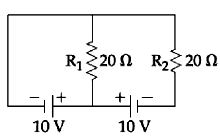
- 7In the given circuit the cells have zero internal resistance. The currents (in Amperes) passing through resistance $R_1$ and $R_2$ respectively, areView Solution
- 8A potentiometer consists of a wire of length $4\, m$ and resistance $10 \,\Omega$. It is connected to cell of $emf$ $2\, V$. The potential difference per unit length of the wire will be ............ $V/m$View Solution
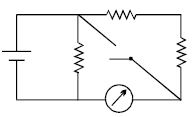
- 9In the circuit shown, the reading of the Ammeter is doubled after the switch is closed. Each resistor has a resistance $ = 1\,\Omega $ and the ideal cell has an $e.m.f. = 10\, V$. Then, the Ammeter has a coil resistance equal to ................ $\Omega$View Solution
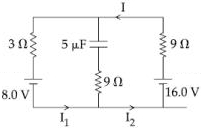
- 10The circuit shown here has two batteries of $8.0\,V$ and $16.0\,V$ and three resistors $3\,\Omega ,\,9\,\Omega $ and $9\,\Omega $ and a capacitor of $5.0\,\mu F.$View Solution
How much is the current $I$ in the circuit in steady state? ................... $A$