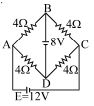
The given figure shows $a$ network of resistances and $a$ battery. Which of the two batteries is getting charged?
Medium


Download our appand get started for free
Experience the future of education. Simply download our apps or reach out to us for more information. Let's shape the future of learning together!No signup needed.*
Similar Questions
- 1A current of $1.6\, A$ is flowing through a wire having cross-sectional area $1\, mm^2$. If density of free electrons in the material of the wire is $10^{29}\, per\, m^3$, the drift velocity of electrons will beView Solution
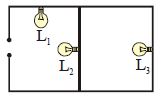
- 2Figure shows three similar lamp. $L_1,L_2$ and $L_3$ connected across a power supply. If the lamp $L_3$ fuses, how will the light emitted by $L_1$ and $L_2$ change ?View Solution
- 3A $10\, m$ long wire of $20\,\Omega$ resistance is connected with a battery of $3\, volt$ $e.m.f.$ (negligible internal resistance) and a $10 \,\Omega$ resistance is joined to it is series. Potential gradient along wire in volt per meter isView Solution
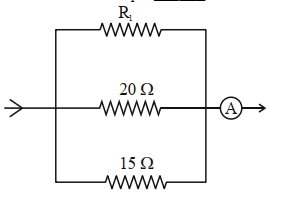
- 4In the given circuit, the current flowing through the resistance $20\ \Omega$ is $0.3 \mathrm{~A}$, while the ammeter reads $0.9 \mathrm{~A}$. The value of $\mathrm{R}_1$ is_____________ $\Omega$.View Solution
- 5View SolutionThe material of fuse wire should have
- 6View SolutionWhich among the following is true
- 7Assertion $(A):$ In a meter bridge experiment, null point for an unknown resistance is put inside an enclosure maintained at a higher temperature. The null point can be obtained at the same $p$ as before by decreasing the value of the standard resistance.View Solution
Reason $(R):$ Resistance of metal increases with increase in temperature.
- 8View SolutionThe amount of heat produced in a resistor when a current is passed through it can be found using
- 9View SolutionThe relaxation time in conductors
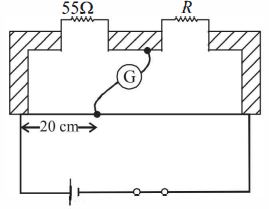
- 10Shown in the figure below is a meter-bridge set up with null deflection in the galvanometer. The value of the unknown resistor $R$ is ............. $\Omega$View Solution