MCQ
The interhalogen which does not exist is
- A$IF_5$
- B$ClF_3$
- ✓$BrCl$
- D$ICl_4$
$(b)\,HCl + Mn{O_4} \to M{n^{2 + }} + C{l_2} \uparrow $
$(c)\,HCl + B{r_2} \to No\,reaction$ $-\left(\Delta G=+v e, \text { because } B r_{2} \text { is weaker oxidant than } C l_{2}\right)$
$(d)\,HCl + {F_2} \to HF + C{l_2} \uparrow $ $\left(\Delta G=-\text { ve }, \text { because } F_{2} \text { is stronger oxidant than } \mathrm{Cl}_{2}\right)$
Generate a complete, print-ready paper with questions like this in minutes — across 16+ boards, with answer keys.
${C_6}{H_5} - N{H_2}\xrightarrow[{HCl}]{{NaN{O_2}}}A\xrightarrow{{CuCN}}B\xrightarrow{{{H_2}/Ni}}C\xrightarrow{{HN{O_2}}}D$
product $(D)$ would be
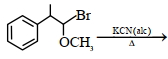
($A$) Formic acid
($B$) Formaldehyde
($C$) Benzaldehyde
($D$) Acetone
Choose the correct answer from the options given below :
$Cu^{+2} +e^-\to Cu^+\,\,\,\,\,E^o = 0.15\,volt$
$Cu^{+2} + 2e^-\to Cu\,\,\,\,\,E^o = 0.34\, volt$
What will be the $E^o$ for half cell
$Cu^+ + e^-\to Cu$ ? ........... $\mathrm{volt}$