MCQ
The kinetic energy force on the particle continuously increases with time.
  • A
    The resultant force on the particle must be parallel to the velocity at all instants.
  • B
    The resultant force on the particle must be at an angle less than 90° all the time.
  • C
    Its height above the ground level must continuously decrease.
  • D
    The magnitude of its linear momentum is increasing continuously.
Answer

  1. The resultant force on the particle must be at an angle less than 90° all the time.
  1. The magnitude of its linear momentum is increasing continuously.
Explanation:

Kinetic energy of a particle is directly proportional to the square of its velocity. The resultant force on the particle must be at an angle less than 90° with the velocity all the time so that the velocity or kinetic energy of the particle keeps on increasing.

The kinetic energy is also directly proportional to the square of its momentum, therefore it continuously increases with the increase in momentum of the particle. 

Need a full question paper?

Generate a complete, print-ready paper with questions like this in minutes — across 16+ boards, with answer keys.

Start Generating Free

Similar questions

A packet contains silver powder of mass $20.23 \,g \pm 0.01 \,g$. Some of the powder of mass $5.75 \,g \pm 0.01 \,g$ is taken out from it. The mass of the powder left back is ................
A drop of liquid of diameter $2.8\, mm$ breaks up into $125$ identical drops. The change in energy is nearly ........ $erg$ (S.T. of liquid = $75\, dynes/cm$)
The magnetic moment has dimensions of
The frequency of transverse vibrations in a stretched string is $200 Hz$. If the tension is increased four times and the length is reduced to one-fourth the original value, the frequency of vibration will be  .... $Hz$
Four identical rods of same material are joined end to end to form a square. If the temperature difference between the ends of a diagonal is ${100^o}C$, then the temperature difference between the ends of other diagonal will be ........ $^oC$
How much work is required to making a soap bubble solution whose radius is r?
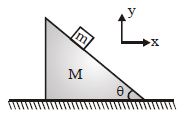
Consider the shown arrangement. Assume all surfaces to be smooth. If $N$ represents magnitudes of normal reaction between block and wedge, then acceleration of $M$ along horizontal equals
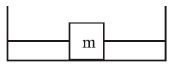
A block of mass $m$ is having two similar rubber ribbons attached to it as shown in the figure. The force constant of each rubber ribbon is $K$ and surface is frictionless. The block is displaced from mean position by $x\,cm$ and released. At the mean position the ribbons are underformed. Vibration period is
A $ 60 kg$  man runs  up a staircase in $ 12$  seconds while a $ 50 kg$  man runs up the same staircase in $11$ , seconds, the ratio of the rate of doing their work is
The equation of motion of a projectile is $y=12 x-\frac{3}{4} x^2$ $..........\,m$ is the range of the projectile.