Question
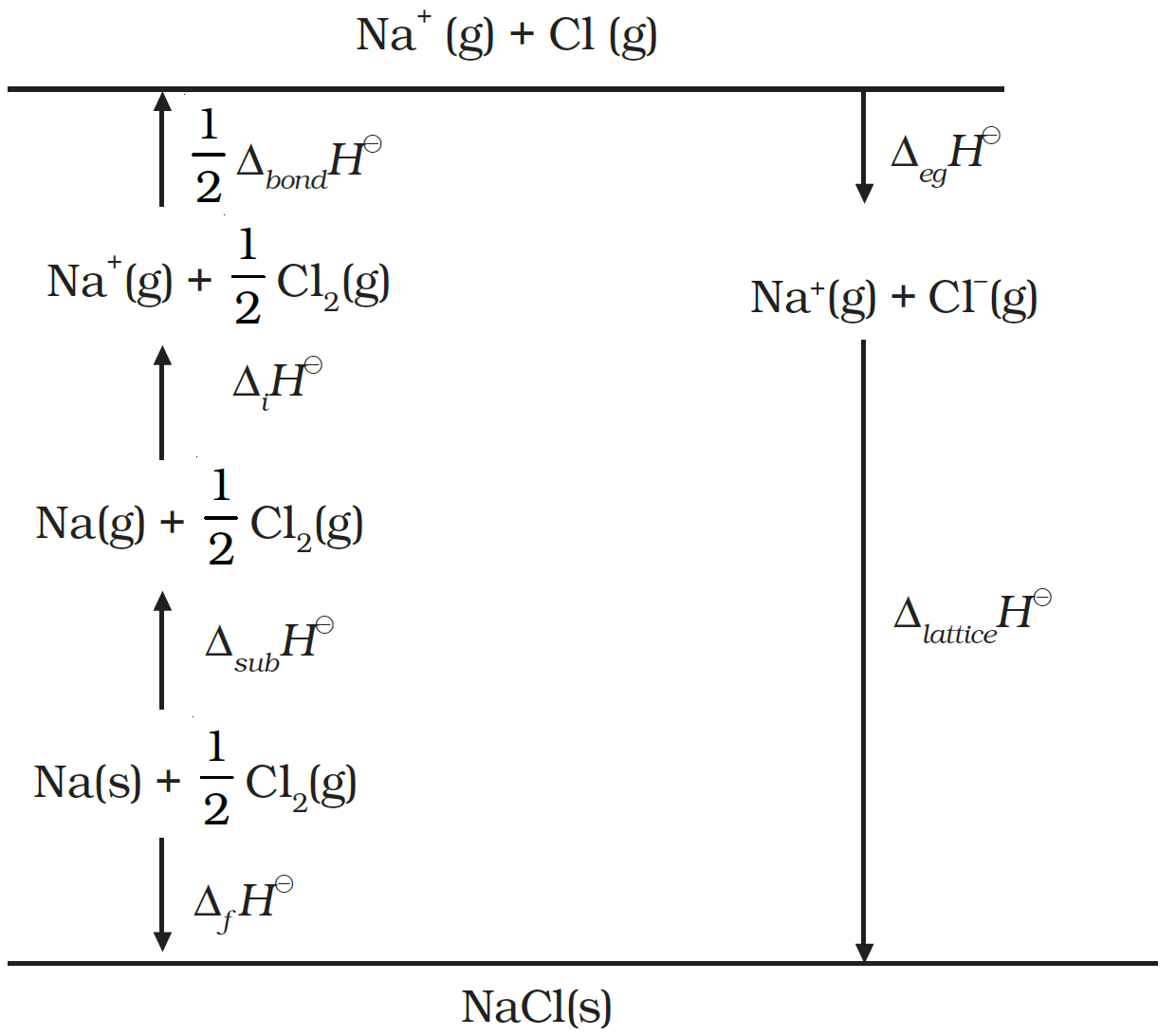
The lattice enthalpy of an ionic compound is the enthalpy when one mole of an ionic compound present in its gaseous state, dissociates into its ions. It is impossible to determine it directly by experiment. Suggest and explain an indirect method to measure lattice enthalpy of NaCl(s).
Answer


• $\text{Na}(\text{s})+\frac{1}{2}\text{Cl}_2(\text{g})\rightarrow\text{Na}^+(\text{g})+\text{Cl}^-(\text{g});$ $\Delta_\text{lattice}\text{H}^\ominus$
• Born - Haber Cycle.
• Steps to measure lattice enthalpy from Bonn - Haber cycle.
• Sublimation of sodium metal.
  1. $\text{Na}(\text{s})\rightarrow\text{Na}(\text{g});$ $\Delta_\text{sub}\text{H}^\ominus$
  2. Ionisation of sodium atom $\text{Na}(\text{g})\rightarrow\text{Na}^+(\text{g})+\text{e}^-(\text{g});$ $\Delta_\text{t}\text{H}^\ominus$ i.e., ionisation enthalpy.
  3. Dissociation of chlorine molecule $\frac{1}{2}\text{Cl}_2(\text{g})\rightarrow\text{Cl}(\text{g});$ $\frac{1}{2}\Delta_\text{bond}\text{H}^\ominus$ i.e., One - half of bond dissociation enthalpy.
  4. $\text{Cl}(\text{g})+\text{e}^-(\text{g})\rightarrow\text{Cl}^-(\text{g});$ $\Delta_\text{eg}\text{H}^\ominus$ i.e., electron gain enthalpy.

Need a full question paper?

Generate a complete, print-ready paper with questions like this in minutes — across 16+ boards, with answer keys.

Start Generating Free

Similar questions

Balance the following equations in basic medium by ion-electron method and oxidation number methods and identify the oxidising agent and the reducing agent.$N_2H_4(l) + ClO_3^-(aq) \rightarrow NO(g) + Cl^-(g)$
Draw the structures of $\mathrm{BCl}_3$. $\mathrm{NH}_3$ and $\mathrm{AlCl}_3$ (dimer).
  1. How would you prepare dihydrogen from water by using a reducing agent?
  2. How would you prepare dihydrogen from a substance other than water?
  3. How would you prepare very pure dihydrogen in the laboratory?
1. Suggest a method to purify
i. a liquid which decomposes at its boiling point.
ii. kerosene oil containing water.
iii. camphor containing traces of common salt.
2. Giving justification, categorise the following molecules/ions as nucleophile or electrophile:
$
\begin{aligned}
& HS^{-}, BF_3, C_2 H_5 O^{-},\left(CH_3\right)_3 N:, \\
& C \stackrel{+}{l}, C H_3-\stackrel{+}{C}=O, H_2 N \stackrel{+}{:}, \stackrel{+}{N} O_2
\end{aligned}
$
The ionization constant of $HF , HCOOH$ and HCN at 298 K are $6.8 \times 10^{-4}, 1.8 \times 10-4$ and $4.8 \times 10^{-9}$ respectively. Calculate the ionization constants of the corresponding conjugate base.
What is the pH of 0.001M aniline solution? The ionization constant of aniline can be taken from Table 7.7. Calculate the degree of ionization of aniline in the solution. Also calculate the ionization constant of the conjugate acid of aniline.
What are significant figures? State rules to determine it.
Match the following species with the corresponding conjugate acid.
Species Conjugate acid
i. $\text{NH}_3$ a. $\text{CO}_3^{2-}$
ii. $\text{HCO}_3^-$ b. $\text{NH}_4^+$
iii. $\text{H}_2\text{O}$ c. $\text{H}_3\text{O}^+$
iv. $\text{HSO}_4^-$ d. $\text{H}_2\text{SO}_4$
    e. $\text{H}_2\text{CO}_3$
Which elements have the following electronic configurations? (Use only the periodic table.)
i. $1 s^2, 2 s^2, 2 p^5$
ii. $[\operatorname{Ar}] 4 s^2, 3 d^{10}, 4 p ^1$
iii. $[ Xe ] 6 s^2$
iv. $[ Xe ] 6 s^2, 5 d^1, 4 f ^7$
v. $[ Ar ] 4 s^1, 3 d^{10}$ (exception to rules)
  1. What are nucleophiles? Give one example of nucleophilic addition reaction.
  2. Give one example of functional isomerism.
  3. Explain the principle of paper chromatography.