The length of a simple pendulum is increased by $1\%$. Its time period will
Easy


Download our appand get started for free
Experience the future of education. Simply download our apps or reach out to us for more information. Let's shape the future of learning together!No signup needed.*
Similar Questions
- 1You are holding a shallow circular container of radius $R$, filled with water to a height $h ( h < < R )$. When yon walk with speed $v$, it is seen that water starts spilling over. This happens due to the resonance of the periodic impulse given to the container (due to walking) with the oscillation of the water in the container. If the time period of water oscillating in the container is inversely proportional to $\sqrt{ h }$, then $v$ is proportional toView Solution
- 2View SolutionA simple pendulum hangs from the ceiling of a car. If the car accelerates with a uniform acceleration, the frequency of the simple pendulum will
- 3The displacement of a particle is given at time $t$, by:$x=A \sin (-2 \omega t)+B \sin ^2 \omega t \quad$ Then,View Solution
- 4Two pendulum have time periods $T$ and $5T/4$. They start $SHM$ at the same time from the mean position. After how many oscillations of the smaller pendulum they will be again in the same phaseView Solution
- 5A solid cylinder of density $\rho_0$, cross-section area $A$ and length $l$ floats in a liquid of density $\rho\left( >\rho_0\right)$ with its axis vertical, as shown. If it is slightly displaced downward and released, the time period will be .......View Solution
- 6A body executes simple harmonic motion under the action of a force $F_1$ with a time period $(4/5)\, sec$. If the force is changed to $F_2$ it executes $SHM$ with time period $(3/5)\, sec$. If both the forces $F_1$ and $F_2$ act simultaneously in the same direction on the body, its time period (in $seconds$ ) isView Solution
- 7View SolutionThe graph shows the variation of displacement of a particle executing S.H.M. with time. We infer from this graph that
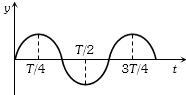
- 8A stationary tuning fork is in resonance with an air column in a pipe. If the tuning fork is moved with a speed of $2 ms ^{-1}$ in front of the open end of the pipe and parallel to it, the length of the pipe should be changed for the resonance to occur with the moving tuning fork. If the speed of sound in air is $320 ms ^{-1}$, the smallest value of the percentage change required in the length of the pipe is. . . . . .View Solution
- 9Two identical spring of constant $K$ are connected in series and parallel as shown in figure. A mass $m$ is suspended from them. The ratio of their frequencies of vertical oscillations will beView Solution
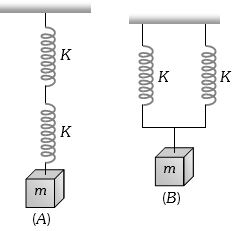
- 10A potential is given by $V(x)=k(x+a)^2 / 2$ for $x < 0$ and $V(x)=k(x-a)^2 / 2$ for $x > 0$. The schematic variation of oscillation period $T$ for a particle performing periodic motion in this potential as a function of its energy $E$ isView Solution