The lowest resistance which can be obtained by connecting $10$ resistors each of $1/10$ $ohm$ is
Easy
Download our app for free and get started
(c)Lowest resistance will be in the case when all the resistors are connected in parallel.
$\frac{1}{R} = \frac{1}{{0.1}} + \frac{1}{{0.1}}$ ....... $10$ times
$\frac{1}{R} = 10 + 10$ ....... $10$ times
$\frac{1}{R} = 100$ i.e. $R = \frac{1}{{100}}\,\Omega $

Download our appand get started for free
Experience the future of education. Simply download our apps or reach out to us for more information. Let's shape the future of learning together!No signup needed.*
Similar Questions
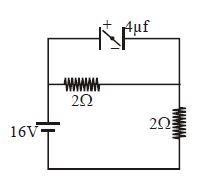
- 1What is net force on the small dipole placed inside the capacitor at steady state if the plates are separated by $1\ cm$ ?......$N$View Solution
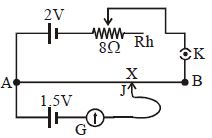
- 2In a potentiometer experiment shown here, for the position $X$ of the jockey $J,$ there occurs a null deflection in the galvanometer. Then the potential difference between points $A$ and $X$ is ................ $V$View Solution
- 3The resistance of a wire is $R$. It is bent at the middle by $180^{\circ}$ and both the ends are twisted together to make a shorter wire. The resistance of the new wire isView Solution
- 4$n$ identical cells are joined in series with two cells $A$ and $B$ with reversed polarities. $emf$ of each cell is $E$ and internal resistance is $r$. Potential difference across cell $A$ and $B$ is : $(n > 4)$View Solution
- 5A certain wire has a resistance $R$. The resistance of another wire identical with the first except having twice its diameter isView Solution
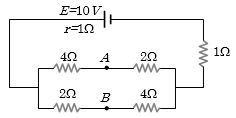
- 6In the circuit shown below, the cell has an $e.m.f.$ of $10\,V$ and internal resistance of $1\, ohm$. The other resistances are shown in the figure. The potential difference ${V_A} - {V_B}$ is ................ $V$View Solution
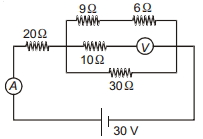
- 7In the circuit shown in figure, if ammeter and voltmeter are ideal, then the power consumed in $9 \,\Omega$ resistor will be .......... $W$View Solution
- 8View SolutionConstantan wire is used in making standard resistances because its
- 9All resistances in figure are $1\,\Omega$ each. The value of current ' $I$ ' is $\frac{a}{5}\,A$. The value of $a$ isView Solution
- 10A metallic block has no potential difference applied across it, then the mean velocity of free electrons is $T$ = absolute temperature of the block)View Solution