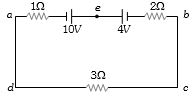
The magnitude and direction of the current in the circuit shown will be
Medium
Download our app for free and get started
Since ${E_1}(10\,V) > {E_2}(4\,V)$
So current in the circuit will be clockwise.
Applying Kirchoff's voltage law
$ - \,1 \times i + 10 - 4 - 2 \times i - 3i = 0$ $ \Rightarrow $ $i = 1\,A$ $(a$ to $b$ via $e)$
Current $ = \frac{V}{R} = \frac{{10 - 4}}{6} = 1.0\,ampere$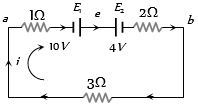

Download our appand get started for free
Experience the future of education. Simply download our apps or reach out to us for more information. Let's shape the future of learning together!No signup needed.*
Similar Questions
- 1A storage cell is charged by $5\, amp$ $D.C.$ for $18$ hours. Its strength after charging will be .............. $AH$View Solution
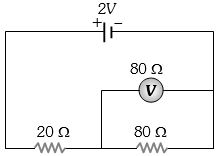
- 2In the adjoining circuit, the $e.m.f.$ of the cell is $2\, volt$ and the internal resistance is negligible. The resistance of the voltmeter is $80 \,ohm$. The reading of the voltmeter will be ............. $volt$View Solution
- 3If a wire of resistance $R$ is melted and recasted to half of its length, then the new resistance of the wire will beView Solution
- 4A car battery of $e.m.f$. $12\,V$ and internal resistance $5 \times {10^{ - 2}}\,\Omega $, receives a current of $60\; A$ from external source, then terminal voltage of battery isView Solution
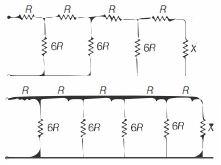
- 5For what value of the resistor $X$ will the equivalent resistance of the two circuits shown be the same?View Solution
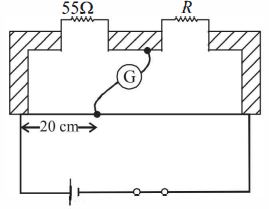
- 6Shown in the figure below is a meter-bridge set up with null deflection in the galvanometer. The value of the unknown resistor $R$ is ............. $\Omega$View Solution
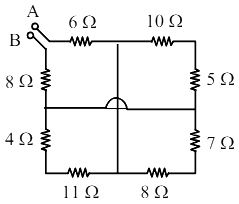
- 7The equivalent resistance between $A$ and $B$ is:View Solution
- 8A cell of $emf\;4\,V$ and internal resistance $0.5\,\Omega$ is connected to a $7.5\,\Omega$ external resistance. The terminal potential difference of the cell is $.....\,V$.View Solution
- 9Infinite number of cells having $emf$ and internal resistance $\left( {E,r} \right)$, $\left( {\frac{E}{n},\frac{r}{n}} \right)$, $\left( {\frac{E}{{{n^2}}},\frac{r}{{{n^2}}}} \right)$, $\left( {\frac{E}{{{n^3}}},\frac{r}{{{n^3}}}} \right)$..... are connected in series in same manner across an external resistance of $\frac{{nr}}{{n + 1}}$ . Current flowing through the external resistor isView Solution
- 10If the ammeter in the given circuit reads $2\, A$, the resistance $R$ is ............ $ohm$View Solution