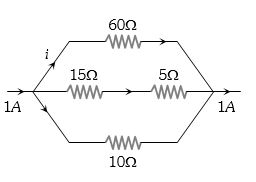
The magnitude of $i$ in ampere unit is
Diffcult
Download our app for free and get started
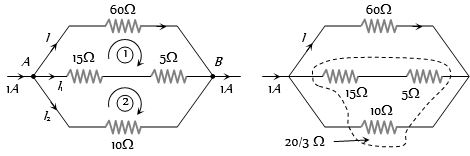
(a) Applying Kirchoff's law in following figure.
At junction $A$ :
$i + {i_1} + {i_2} = 1$ .... $(i)$
For Loop $(i)$
$ - \,60\,i + (15 + 5){i_1} = 0$
$==>$ ${i_1} = 3i$ ...$(ii)$
For loop $(2)$
$-(15 + 5) i_1 + 10 i_2 = 0$
$==>$ $i_2 = i_1 = (3 i) = 6i$
On solving equation $(i), (ii)$ and $(iii)$ we get $i$ =$ 0.1\, A$
Short Trick : Branch current $=$
$\,{\rm{main current }}\left( {\frac{{{\rm{Resistance \,of \,opposite\, branch}}}}{{{\rm{Total\, resistance}}}}} \right)$
$==>$ $i = 1 \times \left[ {\frac{{\frac{{20}}{3}}}{{\frac{{20}}{3} + 60}}} \right]$
$=$ $0.1\, A$
At junction $A$ :
$i + {i_1} + {i_2} = 1$ .... $(i)$
For Loop $(i)$
$ - \,60\,i + (15 + 5){i_1} = 0$
$==>$ ${i_1} = 3i$ ...$(ii)$
For loop $(2)$
$-(15 + 5) i_1 + 10 i_2 = 0$
$==>$ $i_2 = i_1 = (3 i) = 6i$
On solving equation $(i), (ii)$ and $(iii)$ we get $i$ =$ 0.1\, A$
Short Trick : Branch current $=$
$\,{\rm{main current }}\left( {\frac{{{\rm{Resistance \,of \,opposite\, branch}}}}{{{\rm{Total\, resistance}}}}} \right)$
$==>$ $i = 1 \times \left[ {\frac{{\frac{{20}}{3}}}{{\frac{{20}}{3} + 60}}} \right]$
$=$ $0.1\, A$

Download our appand get started for free
Experience the future of education. Simply download our apps or reach out to us for more information. Let's shape the future of learning together!No signup needed.*
Similar Questions
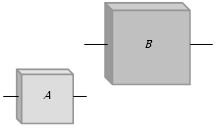
- 1$A$ and $B$ are two square plates of same metal and same thickness but length of $B$ is twice that of $A$. Ratio of resistances of $A$ and $B$ isView Solution
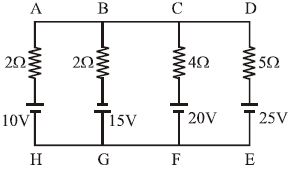
- 2In the given network current through branch $BG$ is almost equal to ............ $A$View Solution
- 3If a wire of resistance $20\,\Omega $ is covered with ice and a voltage of $210\, V$ is applied across the wire, then the rate of melting of ice is .................. $g/s$View Solution
- 4What will happen when a $40\, watt$, $220\, volt$ lamp and $100\, watt$, $220\, volt$ lamp are connected in series across $40\, volt$ supplyView Solution
- 5In a potentiometer experiment the balancing with a cell is at length $240\, cm$. On shunting the cell with a resistance of $2$ $\Omega$, the balancing length becomes $120\, cm$. The internal resistance of the cell is ................. $\Omega $View Solution
- 6A copper wire of length $1\, m$ and radius $1\, mm$ is joined in series with an iron wire of length $2\, m$ and radius $3\, mm$ and a current is passed through the wires. The ratio of the current density in the copper and iron wires isView Solution
- 7To measure the internal resistance of a battery, potentiometer is used. For $\mathrm{R}=10 \Omega$, the balance point is observed at $\ell=500 \mathrm{~cm}$ and for $\mathrm{R}=1 \Omega$ the balance point is observed at $\ell=400 \mathrm{~cm}$. The internal resistance of the battery is approximately :View Solution
- 8View SolutionIf in the experiment of Wheatstone's bridge, the positions of cells and galvanometer are interchanged, then balance points will
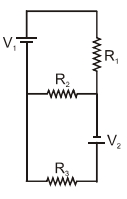
- 9Two ideal batteries of emf $V _1$ and $V _2$ and three resistances $R _1, R _2$ and $R _3$ are connected as shown in the figure.View Solution
The current in resistance $R _2$ would be zero if
$(A)$ $V_1=V_2$ and $R_1=R_2=R_3$
$(B)$ $V_1=V_2$ and $R_1=2 R_2=R_3$
$(C)$ $V_1=2 V_2$ and $2 R_1=2 R_2=R_3$
$(D)$ $2 V _1= V _2$ and $2 R _1= R _2= R _3$
- 10The length of a metallic wire is increased by $20 \%$ and its area of cross section is reduced by $4 \%$. The percentage change in resistance of the metallic wire is $.......$View Solution