A copper wire of length $1\, m$ and radius $1\, mm$ is joined in series with an iron wire of length $2\, m$ and radius $3\, mm$ and a current is passed through the wires. The ratio of the current density in the copper and iron wires is
Easy


Download our appand get started for free
Experience the future of education. Simply download our apps or reach out to us for more information. Let's shape the future of learning together!No signup needed.*
Similar Questions
- 1A battery of $24$ cells, each of emf $1.5\, V$ and internal resistance $2\, \Omega$ is to be connected in order to send the maximum current through a $12 \,\Omega$ resistor. The correct arrangement of cells will beView Solution
- 2A storage battery has $e.m.f.$ $15\, volts$ and internal resistance $0.05\, ohm$. Its terminal voltage when it is delivering $10\, ampere$ is ............... $volts$View Solution
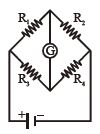
- 3The resistances in $WSB$ circuit shown in the diagram all are different and the current through the galvanometer is zero. If all thermal effects are negligible, the current through the galvanometer will not be zero, whenView Solution
- 4If $n,\,e,\,\tau $ and $m$ respectively represent the density, charge relaxation time and mass of the electron, then the resistance of a wire of length $l$ and area of cross-section $A$ will beView Solution
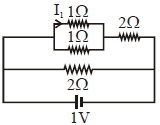
- 5The current $I_{1}$ (in $A$) flowing through $1\; \Omega$ resistor in the following circuit is:View Solution
- 6View SolutionThe relaxation time in conductors
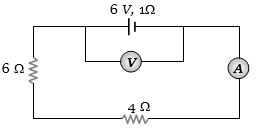
- 7View SolutionIn the circuit shown here, the readings of the ammeter and voltmeter are
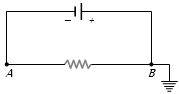
- 8A battery is connected to a uniform resistance wire $AB$ and $B$ is earthed. Which one of the graphs below shows how the current density $J$ varies along $AB$View Solution
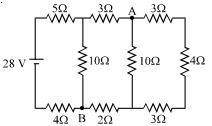
- 9View SolutionConsider the circuit shown in the figure
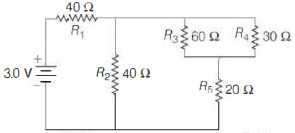
- 10In the circuit shown below, the resistances are given (in $\Omega$ ) and the battery is assumed ideal with emf equal to $3.0 \,V$. The resistor that dissipates the most power isView Solution