Question
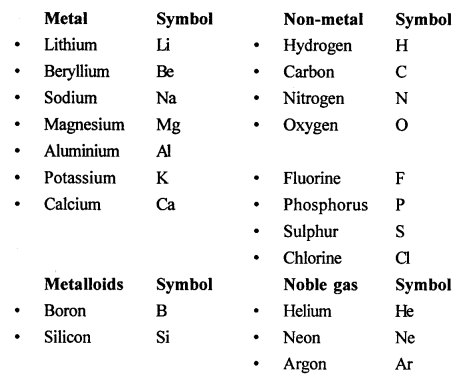
‘The modern periodic table consists of elements arranged according to their increasing atomic numbers’. With reference to elements with atomic numbers $1$ to $20$ only in the periodic table $–$ differentiate them into $–$ metallic elements, metalloids, non$-$metals $\&$ noble gases.
Answer

Names and symbols of metal, non$-$metals, metalloids and noble gases out of $1^{st} 20$ elements.
Image

Need a full question paper?

Generate a complete, print-ready paper with questions like this in minutes — across 16+ boards, with answer keys.

Start Generating Free

Similar questions

With reference to inter-conversion of matter $–$ on the basis of kinetic theory $–$ explain in brief the conversion of:
$(a)$ A solid into a liquid
$(b)$ A liquid into vapour $[$or gas$]$
$(c)$ Vapour [or gas] into a liquid
$(d)$ A liquid into a solid
With special reference to inter$-$particle space $\&$ interparticle attraction at the different stages of conversion.
What are the ways by which a chemical equation can be made more informative ?
Match the statements in Column $A$ with those in Column $B.$
Column $A$ Column $B$
$1.$ A metal which reacts with cold water to from hydrogen. $1.$ Reduction
$2.$ A gas which is inflammable and non$-$supporter of combustion $2.$ Hydrogenation
$3.$ A process in which vanspati ghee is prepared from vegitable oils $3.$ oxidation
$4.$ The removal ofhydrogen or addition of oxygen $4.$ sodium
$5.$ The addition of hydrogen or removal of oxygen $5.$ Hydrogen
Define water of crystallization. Give two examples with formulae.
State which of the following ions or radicals given below of non$-$metallic elements exhibit$-$valency : $1^–, 2^– \ \& \ 3^–$
$(a)$ Chloride
$(b)$ Bromide
$(c)$ Iodide
$(d)$ Nitrate
$(e)$ Hydroxide
$(f)$ Bicarbonate
$(g)$ Bisulphite
$(h)$ Bisulphate
$(i)$ Aluminate
$(j)$ Permanganate
$(k)$ Oxide
$(l)$ Sulphide
$(m)$ Sulphite
$(n)$ Sulphate
$(o)$ Carbonate
$(p)$ Dichromate
$(q)$ Zincate
$(r)$ Plumbite
$(s)$ Phosphate
$(t)$ Nitride
$[$write each ion or radical with the correct valency$]$
State the ‘law of conservation of mass’. State the main points of Landolt’s experiment for experimental evidence of the law.
Suggest a suitable technique to separate the constituents of the following mixtures. Also give the reason for selecting the particular method. Salt from sea water
State the main postulates of $-$ Dalton’s atomic theory. Explain how the modern atomic theory contradicted Dalton’s atomic theory.
State the mass number, the atomic number, number of neutrons and electronic configuration of the following atoms.
${ }_6^{12} \mathrm{C},{ }_8^{16} \mathrm{O},{ }_9^{19} \mathrm{~F},{ }_{10}^{20} \mathrm{Ne},{ }_{13} \mathrm{Al}^{27},{ }_{17} \mathrm{Cl}^{35}$
Also, draw atomic diagrams for them.
What happens during a chemical reaction ?