MCQ
The narrowest hysterisis loop is for:
- ACobalt steel.
- BAlnico.
- CPerm alloy.
- DStainless steel.
Generate a complete, print-ready paper with questions like this in minutes — across 16+ boards, with answer keys.
Assertion : The drift velocity of electrons in a metallic wire will decrease, if the temperature of the wire is increased.
Reason : On increasing temperature, conductivity of metallic wire decreases.
|
(a) If both assertion and reason are true and the reason is the correct explanation of the assertion. |
|
(b) If both assertion and reason are true but reason is not the correct explanation of the assertion. |
|
(c) If assertion is true but reason is false. |
|
(d) If the assertion and reason both are false. |
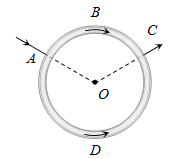
A uniform wire is bent in the form of a circle of radius R. A current I enters at A and leaves at C as shown in the figure :
If the length ABC is half of the length ADC, the magnetic field at the centre O will be
|
(a) Zero |
(b) |
(c) |
(d) |
A double convex thin lens made of glass (refractive index μ = 1.5) has both radii of curvature of magnitude 20 cm. Incident light rays parallel to the axis of the lens will converge at a distance L such that
|
(a) L = 20 cm |
(b) L = 10 cm |
(c) L = 40 cm |
(d) L = 20 / 3 cm |
A constant voltage is applied between the two ends of a metallic wire. If both the length and the radius of the wire are doubled, the rate of heat developed in the wire
|
(a) Will be doubled |
(b) Will be halved |
|
(c) Will remain the same |
(d) Will be quadrupled |
In Young's double slit experiment, if the two slits are illuminated with separate sources, no interference pattern is observed because
|
(a) There will be no constant phase difference between the two waves |
|
(b) The wavelengths are not equal |
|
(c) The amplitudes are not equal |
|
(d) None of the above |


