Question

The ozone layer absorbs

(a) Infrared radiations

(b) Ultraviolet radiations

(c) X-rays  

(d) g-rays

Answer

(b) Ultraviolet radiations

Need a full question paper?

Generate a complete, print-ready paper with questions like this in minutes — across 16+ boards, with answer keys.

Start Generating Free

Similar questions

A thin circular ring of mass M and radius r is rotating about its axis with an angular speed $\omega.$ Two particles having mass m each are now attached at diametrically opposite points. The angular speed of the ring will become:

  1. $\frac{\omega\text{M}}{\text{M}+\text{m}}$

  2. $\frac{\omega\text{M}}{\text{M}+\text{2m}}$

  3. $\frac{\omega(\text{M}-\text{2m})}{\text{M}+\text{2m}}$

  4. $\frac{\omega(\text{M}+\text{2m})}{\text{M}}$
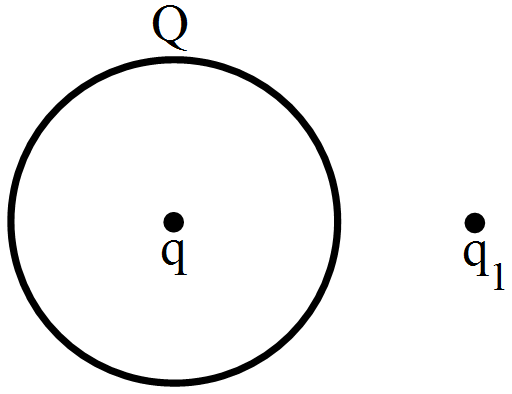
A thin, metallic spherical shell contains a charge Q on it. A point charge q is placed at the centre of the shell and another charge q1 is placed outside it as shown in figure. All the three charges are positive. The force on the charge at the centre is:

  1. Towards left.
  2. Towards right.
  3. Upward.
  4. Zero.
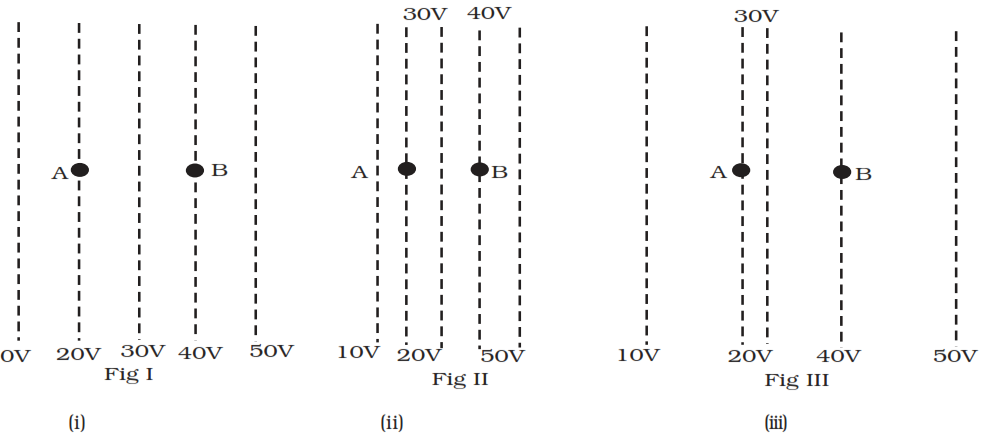
Figure shows some equipotential lines distributed in space. A charged object is moved from point A to point B.

A cubical block of mass M and edge a slides down a rough inclined plane of inclination $\theta$ with a uniform velocity. The torque of the normal force on the block about its centre has a magnitude:

  1. $\text{Zero.}$

  2. $\text{Mga}$

  3. $\text{Mga}\sin\theta$

  4. $\frac{1}{2}\text{Mga}\sin\theta$

The order of magnitude of radius of nucleus is ___________.
An electron and a proton are both released from rest 1 meter from a large stationary negative charge, considering only the force from the large stationary negative charge on the proton and electron. Which of the following is true?

A current of 1 mA is flowing through a copper wire.  How many electrons will pass a given point in one second [e = 1.6 × 10⁻¹⁹ Coulomb]

(a) 6.25 ×  

(b) 6.25 ×  

(c) 6.25 ×

(d) 6.25 ×  

The electron emitted in beta radiation originates from:
Field lines are shown close together where the
If $f$ is focal length and $u$ is object distance for spherical mirror, then lateral magnification $m=$ __________ .