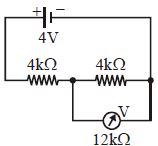
The percentage error in the reading of the voltmeter in the figure shown here is nearly ............ $\%$
Medium


Download our appand get started for free
Experience the future of education. Simply download our apps or reach out to us for more information. Let's shape the future of learning together!No signup needed.*
Similar Questions
- 1When a current of $2\, A$ flows in a battery from negative to positive terminal, the potential difference across it is $12\, V$. If a current of $3\, A$ flows in the opposite direction potential difference across the terminals of the battery is $15\, V$, the $emf$ of the battery is ............... $\mathrm{V}$View Solution
- 2Two wires $A$ and $B$ of same material and mass have their lengths in the ratio $1 : 2$. On connecting them to the same source, the rate of heat dissipation in $B$ is found to be $5\,W$. The rate of heat dissipation in $A$ is............ $W$View Solution
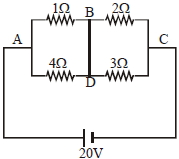
- 3In the given circuit diagram, a wire is joining points $B$ and $D$. The current in this wire is ............. $A$View Solution
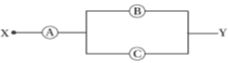
- 4$A, \,B$ and $C$ are voltmeters of resistance $R, \,1 .5R$ and $3R$ respectively as shown in the figure. When some potential difference is applied between $X$ and $Y,$ the voltmeter readings are $V_A, \,V_B$ and $V_C$ respectively. ThenView Solution
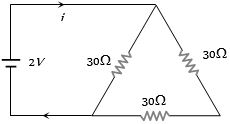
- 5View SolutionThe current in the adjoining circuit will be
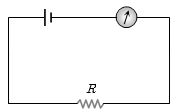
- 6A battery of $e.m.f.$ $10\, V$ and internal resistance $3\,\Omega $ is connected to a resistor as shown in the figure. If the current in the circuit is $0.5\, A$. then the resistance of the resistor will be ............. $\Omega$View Solution
- 7A cell sends a current through a resistance $R$ for time $t$. Now the same cell sends current through another resistance $r$ for the same time. If same amount of heat is developed in both the resistance, then the internal resistance of cell isView Solution
- 8Four equal resistance dissipated $5 \,W$ of power together when connected in series to a battery of negligible internal resistance. The total power dissipated in these resistance when connected in parallel across the same battery would be ........... $W$View Solution
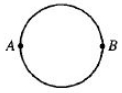
- 9A wire of resistance $12\,ohms$ per meter is bent to form a complete circle of radius $10\, cm.$ The resistance between its two diametrically opposite points, $A$ and $B$ as shown in the figure isView Solution
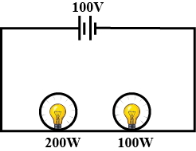
- 10Two bulbs, one of $200 \,W$ and the other of $100 \,W$ are connected in series with a $100 \,V$ battery which has no internal resistance. Then,View Solution