When a current of $2\, A$ flows in a battery from negative to positive terminal, the potential difference across it is $12\, V$. If a current of $3\, A$ flows in the opposite direction potential difference across the terminals of the battery is $15\, V$, the $emf$ of the battery is ............... $\mathrm{V}$
Medium
Download our app for free and get started
$\mathrm{T} . \mathrm{P.D.}=\mathrm{E}-\mathrm{I} \mathrm{r} \Rightarrow 12=\mathrm{E}-2 \mathrm{r}$ ..........$(1)$
$\mathrm{T.P.D.}=\mathrm{E}+\mathrm{Ir} \Rightarrow 15=\mathrm{E}+3 \mathrm{r} $ .........$(2)$
Solve ${\rm{e}}{{\rm{q}}^n}$ $(1)$ and $(2)$

Download our appand get started for free
Experience the future of education. Simply download our apps or reach out to us for more information. Let's shape the future of learning together!No signup needed.*
Similar Questions
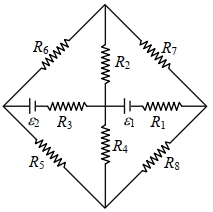
- 1The figure shows a circuit having eight resistances of $1 \Omega$ each, labelled $R_1$ to $R_8$, and two ideal batteries with voltages $\varepsilon_1=12 V$ and $\varepsilon_2=6 V$.View Solution
Which of the following statement($s$) is(are) correct?
$(A)$ The magnitude of current flowing through $R_1$ is $7.2 A$.
$(B)$ The magnitude of current flowing through $R_2$ is $1.2 A$.
$(C)$ The magnitude of current flowing through $R_3$ is $4.8 A$.
$(D)$ The magnitude of current flowing through $R_5$ is $2.4 A$.
- 2The current in a wire varies with time according to relation $I = 4 + 2t$. The quantity of charge which has passed through a crosssectionn of the wire during the time $t = 2\, s$ to $t = 6\, s$ will be .............. $\mathrm{C}$View Solution
- 3View SolutionWhen a piece of aluminium wire of finite length is drawn through a series of dies to reduce its diameter to half its original value, its resistance will become ........ times
- 4The temperature coefficient of resistance of tungsten is $4.5 \times 10^{-3}{ }^{\circ} C ^{-1}$ and that of germanium is $-5 \times 10^{-2}{ }^{\circ} C ^{-1}$. A tungsten wire of resistance $100 \,\Omega$ is connected in series with a germanium wire of resistance $R$. The value of $R$ for which the resistance of combination does not change with temperature is .......... $\Omega$View Solution
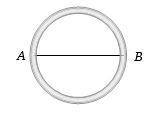
- 5The resistance of a wire is ${10^{ - 6}}\,\Omega $ per meter. It is bend in the form of a circle of diameter $2\,m$. A wire of the same material is connected across its diameter. The total resistance across its diameter $AB$ will beView Solution
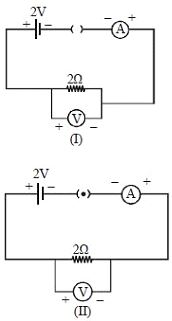
- 6For the circuits shown in figures $I$ and $II$, the voltmeter reading would beView Solution
- 7When a current of $2\,A$ flows in a battery from negative to positive terminal, the potential difference across it is $12\,V$. If a current of $3\,A$ flows in the opposite direction potential difference across the terminals of the battery is $15\,V$, the emf of the battery is ............... $\mathrm{V}$View Solution
- 8View SolutionIn a metallic conductor, under the effect of applied electric field, the free electrons of the conductor
- 9An electric bulb is designed to draw power $P_0$ at voltage $V_0$. If the voltage is $V$ it draws a power $P$. ThenView Solution
- 10In order to increase the resistance of a given wire of uniform cross section to four times its value, a fraction of its length is stretched uniformly till the full length of the wire becomes $\frac{3}{2}$ times the original length what is the value of this fraction?View Solution