The phase (at a time $t$) of a particle in simple harmonic motion tells
Easy


Download our appand get started for free
Experience the future of education. Simply download our apps or reach out to us for more information. Let's shape the future of learning together!No signup needed.*
Similar Questions
- 1The velocity vector $v$ and displacement vector $x$ of a particle executing SHM are related as $\frac{v d v}{d x}=-\omega^2 x$ with the initial condition $v=v_0$ at $x=0$. The velocity $v$, when displacement is $x$, isView Solution
- 2View SolutionThe graph in figure represents
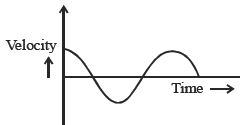
- 3View SolutionThe graph between velocity and position for a damped oscillation will be
- 4The velocity of a particle executing SHM varies with displacement $( x )$ as $4 v ^2=50- x ^2$. The time period of oscillations is $\frac{x}{7} s$. The value of $x$ is $............$ $\left(\right.$ Take $\left.\pi=\frac{22}{7}\right)$View Solution
- 5Let $T_1$ and $T_2$ be the time periods of two springs $A$ and $B$ when a mass $m$ is suspended from them separately. Now both the springs are connected in parallel and same mass $m$ is suspended with them. Now let $T$ be the time period in this position. ThenView Solution
- 6A particle of mass $m$ performs $SHM$ along a straight line with frequency $f$ and amplitude $A.$View Solution
- 7If $x = a\sin \left( {\omega t + \frac{\pi }{6}} \right)$ and $x' = a\cos \omega t$, then what is the phase difference between the two wavesView Solution
- 8The $K.E.$ and $P.E.$ of a particle executing $SHM$ with amplitude $A$ will be equal when its displacement is-View Solution
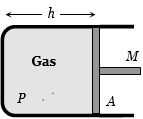
- 9A cylindrical piston of mass $M$ slides smoothly inside a long cylinder closed at one end, enclosing a certain mass of gas. The cylinder is kept with its axis horizontal. If the piston is disturbed from its equilibrium position, it oscillates simple harmonically. The period of oscillation will beView Solution
- 10In the reported figure, two bodies $A$ and $B$ of masses $200\, {g}$ and $800\, {g}$ are attached with the system of springs. Springs are kept in a stretched position with some extension when the system is released. The horizontal surface is assumed to be frictionless. The angular frequency will be $.....\,{rad} / {s}$ when ${k}=20 \,{N} / {m} .$View Solution
