MCQ
The position vector of a particle changes with time according to the relation $\vec r\left( t \right) = 15{t^2}\hat i + \left( {4 - 20{t^2}} \right)\hat j$. What is the magnitude of the acceleration at $t = 1$ ?
  • A
    $40$
  • B
    $100$
  • C
    $25$
  • $50$

Answer

Correct option: D.
$50$
d
$\begin{array}{l}
\vec r = \left( {15{t^2}} \right)\hat i + \left( {4 - 20{t^2}} \right)\hat j\\
\vec v = \frac{{d\vec r}}{{dt}} = \left( {30t} \right)\hat i - \left( {40t} \right)\hat j\\
\vec a = \frac{{d\vec v}}{{dt}} = \left( {30} \right)\hat i - \left( {40} \right)\hat j\\
\left| {\vec a} \right| = 50
\end{array}$

Need a full question paper?

Generate a complete, print-ready paper with questions like this in minutes — across 16+ boards, with answer keys.
Start Generating Free

Similar questions

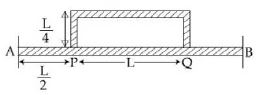
Temperature difference of $120\,^oC$ is maintained between two ends of a uniform rod $AB$ of length $2L$. Another bent rod $PQ$, of same cross-section as $AB$ and length $\frac{{3L}}{2}$,  is connected across $AB$ (See figure). In steady state, temperature difference between $P$ and $Q$ will be close to .......... $^oC$
The number of particles crossing per unit area perpendicular to $X-$axis in unit time is: $\text{N}=-\text{D}\frac{\text{n}_2-\text{n}_1}{\text{x}_2-\text{x}_1}$ Where $n_1$ and $n_2$ are number of particles per unit volume for the value of $x_1$ and $x_2$ respectively. The dimensions of diffusion constant $D$ are:
An experiment takes $10\, minutes$ to raise the temperature of water in a container from $0\,^oC$ to $100\,^oC$ and another $55\, minutes$ to convert it totally into steam by a heater supplying heat at a uniform rate . Neglecting the specific heat of the container and taking specific heat of water to be $1\, cal / g\,^oC$, the heat of vapourization according to this experiment will come out to be ........ $cal/g$
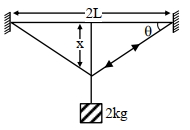
A wire of cross sectional area $A$, modulus of elasticity $2 \times 10^{11} \mathrm{Nm}^{-2}$ and length $2 \mathrm{~m}$ is stretched between two vertical rigid supports. When a mass of $2 \mathrm{~kg}$ is suspended at the middle it sags lower from its original position making angle $\theta=\frac{1}{100}$ radian on the points of support. The value of $A$ is. . . . . .  $\times 10^{-4} \mathrm{~m}^2$ (consider $\mathrm{x}<\mathrm{L}$ ).

(given: $\mathrm{g}=10 \mathrm{~m} / \mathrm{s}^2$ )
Two simple pendulums of length $5m$ and $10m$ respectively are given small linear displacement in one direction at the same time. They will be again in the phase when the pendulum of shorter length has completed oscillations:
A liquid is coming out from a vertical tube. The relation between the weight of the drop $W$, surface tension of the liquid $T$ and radius of the tube $r$ is given by, if the angle of contact is zero
The frequency of a whistle of an engine is $600\, cycles/sec$ is moving with the speed of $30 \,m/sec$ towards an observer. The apparent frequency will be .... $cps$ (velocity of sound $= 330 \,m/s$)
In suspended type moving coil galvanometer, quartz suspension is used because
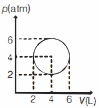
An ideal gas undergoes a circular cycle centred at $4 \,atm , 4 L$ as shown in the diagram. The maximum temperature attained in this process is close to
Two stones are thrown with same speed $u$ at different angles from ground in air. If both stones have same range and height attained by them are $h_1$ and $h_2$, then $h_1+h_2$ is equal to .......