MCQ
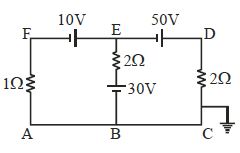
The potential at point $E$ for the given figure is ................ $\mathrm{V}$
  • A
    $3$
  • B
    $5$
  • C
    $-3$
  • $0$

Answer

Correct option: D.
$0$
d
Let potential at point $\mathrm{E}$ be $\mathrm{V}$ and $\mathrm{A}, \mathrm{B}, \mathrm{C}$ are neutral point. (zero potential point)

Apply $\mathrm{KCL}$ at point $\mathrm{E}$

$\frac{\mathrm{V}-10}{1}+\frac{\mathrm{V}-30}{2}+\frac{\mathrm{V}+50}{2}=0$

$2(v-10)+V-30+V+50=0$

$4 \mathrm{V}=0 \quad \Rightarrow \quad \mathrm{V}=0$

Need a full question paper?

Generate a complete, print-ready paper with questions like this in minutes — across 16+ boards, with answer keys.
Start Generating Free

Similar questions

The magnetic materials having negative magnetic susceptibility are:
A wire $A$, bent in the shape of an arc of a circle, carrying a current of $2\, A$ and having radius $2\, cm$ and another wire $B ,$ also bent in the shape of arc of a circle, carrying a current of $3\, A$ and having radius of $4\, cm ,$ are placed as shown in the figure. The ratio of the magnetic fields due to the wires $A$ and $B$ at the common centre $O$ is
Light is incident from a medium into air at two possible angles of incidence $(A)\, 20^o$ and $(B)\, 40^o$ . In the medium light travels $3.0\, cm$ in $0.2\, ns$. The ray will
In a meter bridge experiment resistances are connected as shown in the figure. Initially resistance $P\, = 4\,\Omega $ and the neutral point $N$ is at $60\,cm$ from $A$. Now an unknown resistance $R$ is connected in series to $P$ and the new position of the neutral point is at $80\,cm$ from $A$ . The value of unknown resistance $R$ is
The direction of induced e.m.f. during electromagnetic induction is given by
The radius of electron's second stationary orbit in Bohr's atom is $R$. The radius of the third orbit will be
A capacitor with capacitance $5\,\mu F$ is charged to $5\,\mu C.$ If the plates are pulled apart to reduce the capacitance to $2\,\mu F,$ how much work is done?
For a constant collector-emitter voltage of $8\,V$, the collector current of a transistor reached to the value of $6\,mA$ from $4\,mA$, whereas base current changed from $20\,\mu A$ to $25\,\mu\,A$ value. If transistor is in active state, small signal current gain (current amplification factor) will be.
A semi circular current carrying wire having radius $R$ is placed in $x-y$ plane with its centre at origin $‘O’$. There is non-uniform magnetic $\vec B = \frac{{{B_o}x}}{{2R}}\hat k$ (here $B_o$ is + $ve$ constant) is existing in the region. The  magnetic force acting on semi circular wire will be along
${ }_{92}^{238} U$ is known to undergo radioactive decay to form ${ }_{82}^{206} Pb$ by emitting alpha and beta particles. A rock initially contained $68 \times 10^{-6} g$ of ${ }_{92}^{238} U$. If the number of alpha particles that it would emit during its radioactive decay of ${ }_{92}^{238} U$ to ${ }_{82}^{206} Pb$ in three half-lives is $Z \times 10^{18}$, then what is the value of $Z$?