The potential energy of a simple harmonic oscillator at mean position is $2\,joules$. If its mean $K.E.$ is $4\,joules$, its total energy will be .... $J$
Medium
Download our app for free and get started
Total energy $=\frac{1}{2} \mathrm{KA}^{2}+\mathrm{U}_{0}$
$\mathrm{U}_{0}=2 \mathrm{J}(\text { given })$ and $\frac{1}{4} \mathrm{KA}^{2}=4 \mathrm{J}$
So total energy $=8+2=10 \mathrm{J}$

Download our appand get started for free
Experience the future of education. Simply download our apps or reach out to us for more information. Let's shape the future of learning together!No signup needed.*
Similar Questions
- 1A particle executes simple harmonic motion along a straight line with an amplitude $A$. The potential energy is maximum when the displacement isView Solution
- 2The displacement of a particle undergoing $SHM$ of time period $T$ is given by $x(t) = x_m\,cos\, (\omega t + \phi )$. The particle is at $x = -x_m$ at time $t = 0$. The particle is at $x = + x_m$ whenView Solution
- 3The total energy of particle performing $S.H.M.$ depend onView Solution
- 4The $S.H.M.$ of a particle is given by the equations $=2 \sin \omega t+4 \cos \omega t$. Its amplitude of oscillation is ........ unitsView Solution
- 5The particle executing simple harmonic motion has a kinetic energy $K_0cos^2 \omega t$. The maximum values of the potential energy and the total energy are respectivelyView Solution
- 6A vertical mass-spring system executes simple harmonic oscillations with a period of $2\,s$. A quantity of this system which exhibits simple harmonic variation with a period of $1\, s$ isView Solution
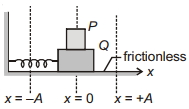
- 7In the figure shown, there is friction between the blocks $P$ and $Q$ but the contact between the block $Q$ and lower surface is frictionless. Initially the block $Q$ with block $P$ over it lies at $x=0$, with spring at its natural length. The block $Q$ is pulled to right and then released. As the spring - blocks system undergoes $S.H.M.$ with amplitude $A$, the block $P$ tends to slip over $Q . P$ is more likely to slip atView Solution
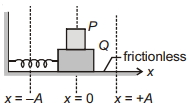
- 8In the figure shown, there is friction between the blocks $P$ and $Q$ but the contact between the block $Q$ and lower surface is frictionless. Initially the block $Q$ with block $P$ over it lies at $x=0$, with spring at its natural length. The block $Q$ is pulled to right and then released. As the spring - blocks system undergoes $S.H.M.$ with amplitude $A$, the block $P$ tends to slip over $Q . P$ is more likely to slip atView Solution
- 9A plate oscillated with time period $‘T’$. Suddenly, another plate put on the first plate, then time periodView Solution
- 10A particle of mass $250\,g$ executes a simple harmonic motion under a periodic force $F =(-25\,x) N$. The particle attains a maximum speed of $4\,m / s$ during its oscillation. The amplitude of the motion is $...........cm$.View Solution