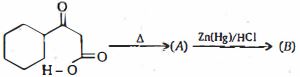
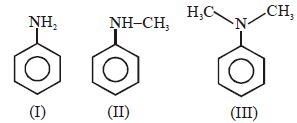
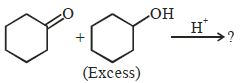
MCQ
The reaction $2{N_2}{O_5}$ $\rightleftharpoons$ $2{N_2}{O_4} + {O_2}$ is
- ABimolecular and second order
- BUnimolecular and first order
- ✓Bimolecular and first order
- DBimolecular and zero order
Generate a complete, print-ready paper with questions like this in minutes — across 16+ boards, with answer keys.
${CH}_3-\mathrm{CH}_2-\mathrm{CH}_2-\mathrm{Br} \xrightarrow[\Delta]{\mathrm{KOH}_{(a k)}} \mathrm{A} \xrightarrow{\mathrm{HBr}} \mathrm{B} \xrightarrow[\mathrm{KOH}_{(a) i}]{\Delta} \mathrm{C}$
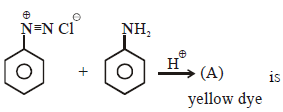
$\mathrm{C}_{3} \mathrm{H}_{6} \stackrel{\mathrm{H}^{+} / \mathrm{H}_{2} \mathrm{O}}{\longrightarrow} A\xrightarrow[dil.\,KOH]{KIO} B+C$
The compounds $B$ and $C$ respectively are :
Reason : Raoult’s law is a special case of Henry’s law.