The resistance of $10\, metre$ long potentiometer wire is $1\,ohm/meter$. A cell of $e.m.f.$ $2.2\, volts$ and a high resistance box are connected in series to this wire. The value of resistance taken from resistance box for getting potential gradient of $2.2\, millivolt/metre$ will be ............... $\Omega $
Medium
Download our app for free and get started
(c) Potential gradient $x = \frac{V}{L} = \frac{e}{{(R + {R_h} + r)}} \cdot \frac{R}{L}$
$ \Rightarrow $ $2.2 \times {10^{ - 3}} = \frac{{2.2}}{{(10 + {R_h})}} \times 1$
$ \Rightarrow $ $R' = 990\,\Omega $

Download our appand get started for free
Experience the future of education. Simply download our apps or reach out to us for more information. Let's shape the future of learning together!No signup needed.*
Similar Questions
- 1Two bulbs are working in parallel order. Bulb $A$ is brighter than bulb $B$. If ${R_A}$ and ${R_B}$ are their resistance respectively thenView Solution
- 2A potential difference of $V$ is applied at the ends of a copper wire of length $l$ and diameter $d$. On doubling only $d$, drift velocityView Solution
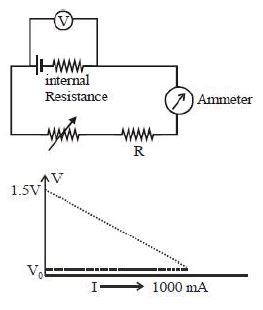
- 3To verify Ohm's law, a student connects the voltmeter across the battery as, shown in the figure. The measured voltage is plotted as a function of the current, and the following graph is obtained If $V_0$ is almost zero, identify the correct statementView Solution
- 4The same mass of copper is drawn into two wires $1\, mm$ and $2\, mm$ thick. Two wires are connected in series and current is passed through them. Heat produced in the wire is in the ratioView Solution
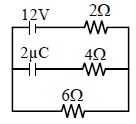
- 5Find the charge on the capacitor $C$ in the given circuit .................. $\mu C$View Solution
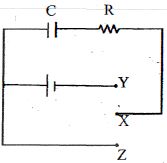
- 6The capacitor $C$ is initially without charge.$X$ is now j oined to $Y$ for a long time, during which $H_1$ heat is produced in the resistance $R$. $X-Y$ connection is removed and $X$ is now joined to $Z$ for a long time, during which heat $H_2$ is produced in $R$.View Solution
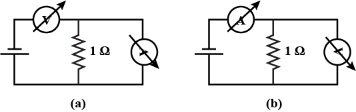
- 7A student uses the resistance of a known resistor $(1 \,\Omega)$ to calibrate a voltmeter and an ammeter using the circuits shown below. The student measures the ratio of the voltage to current to be $1 \times 10^3 \,\Omega$ in circuit $(a)$ and $0.999 \,\Omega$ in circuit $(b)$. From these measurements, the resistance (in $\Omega$ ) of the voltmeter and ammeter are found to be close toView Solution
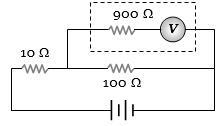
- 8The potential difference across the $100\,\Omega$ resistance in the following circuit is measured by a voltmeter of $900 \,\Omega$ resistance. The percentage error made in reading the potential difference isView Solution
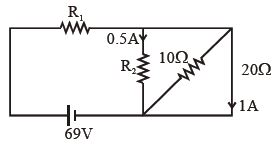
- 9In the circuit shown in the given figure the resistance $R_1$ and $R_2$ are respectivelyView Solution
- 10A certain wire has a resistance $R$. The resistance of another wire identical with the first except having twice its diameter isView Solution