The resistance of an electrical toaster has a temperature dependence given by $R\left( T \right) = {R_0}\left[ {1 + \alpha \left( {T - {T_0}} \right)} \right]$ in its range of operation. At ${T_0} = 300\,K,R = 100\,\Omega $ and at $T = 500\,K,\,R = 120\,\Omega $. The toaster is connected to a voltage source at $200\, V$ and its temperature is raised at a constant rate from $300$ to $500\, K$ in $30\, s$. The total work done in raising the temperature is
JEE MAIN 2016, Diffcult
Download our app for free and get started
$R(T)=R_{o}\left(1+\alpha\left(T-T_{o}\right)\right)$
Applying boundary conditions, $120=100(1+200 \alpha)$
$\alpha=10^{-3}\, K^{-1}$
It is given that temperature increases at a constant rate from $300\, \mathrm{K}$ to $500\, \mathrm{K}$ in $30 \,\mathrm{s}$. Hence, $T(t)=300+20 t / 3$
By Joule's Law, heat dissipated in a resistor is given by:
$W=\int_{0}^{30} \frac{V^{2}}{R} d t$
$=\int_{0}^{30} \frac{V^{2}}{R_{0}\left(1+\alpha\left(T-T_{0}\right)\right)} d t$
$=\frac{V^{2}}{R_{o}} \int_{0}^{30} \frac{1}{(1+20 \alpha t / 3)} d t$
Solving, $W=400 \ln (6 / 5)$
Work done on resistor $=-W=400 \ln (5 / 6) \,J$

Download our appand get started for free
Experience the future of education. Simply download our apps or reach out to us for more information. Let's shape the future of learning together!No signup needed.*
Similar Questions
- 1Masses of $3$ wires of same metal are in the ratio $1 : 2 : 3$ and their lengths are in the ratio $3 : 2 : 1$. The electrical resistances are in ratioView Solution
- 2If a wire of resistance $R$ is melted and recasted to half of its length, then the new resistance of the wire will beView Solution
- 3A heater coil connected to a supply of a $220\, V$ is dissipating some power ${P_1}.$ The coil is cut into half and the two halves are connected in parallel. The heater now dissipates a power ${P_2}.$ The ratio of power ${P_1}\,\,:\,\,{P_2}$ isView Solution
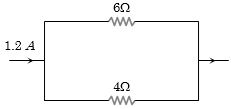
- 4In the figure given below, the current passing through $6\,\Omega $ resistor is ........... $ampere$View Solution
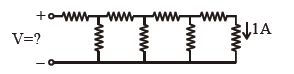
- 5Each element in the finite chain of resistors shown in the figure is $\,1\,\Omega $ . A current of $1\, A$ flows through the final element. Then what is the potential difference $V$ across input terminals of the chain .................. $\mathrm{volt}$View Solution
- 6View SolutionWatt-hour meter measures
- 7It is preferable to measure the $e.m.f.$ of a cell by potentiometer than by a voltmeter because of the following possible reasons.View Solution
$(i)$ In case of potentiometer, no current flows through the cell.
$(ii)$ The length of the potentiometer allows greater precision.
$(iii)$ Measurement by the potentiometer is quicker.
$(iv)$ The sensitivity of the galvanometer, when using a potentiometer is not relevant.
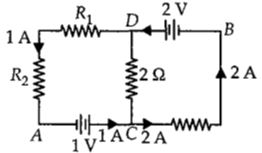
Which of these reasons are correct? - 8In the circuit shown in the figure, if the potential at point $A$ is taken to be zero, the potential at point $B$ is ................ $V$View Solution
- 9A potentiometer wire of length $100\, cm$ has a resistance of $10\, ohm.$ It is connected in series with a resistance and an accumulator of emf $2\,V$ and of negligible internal resistance. A source of emf $10\, mV$ is balanced against a length of $40\, cm$ of the potentiometer wire. What is the value of external resistance :- ................. $\Omega$View Solution
- 10$A$ and $B$ are two square plates of same metal and same thickness but length of $B$ is twice that of $A$. Ratio of resistances of $A$ and $B$ isView Solution